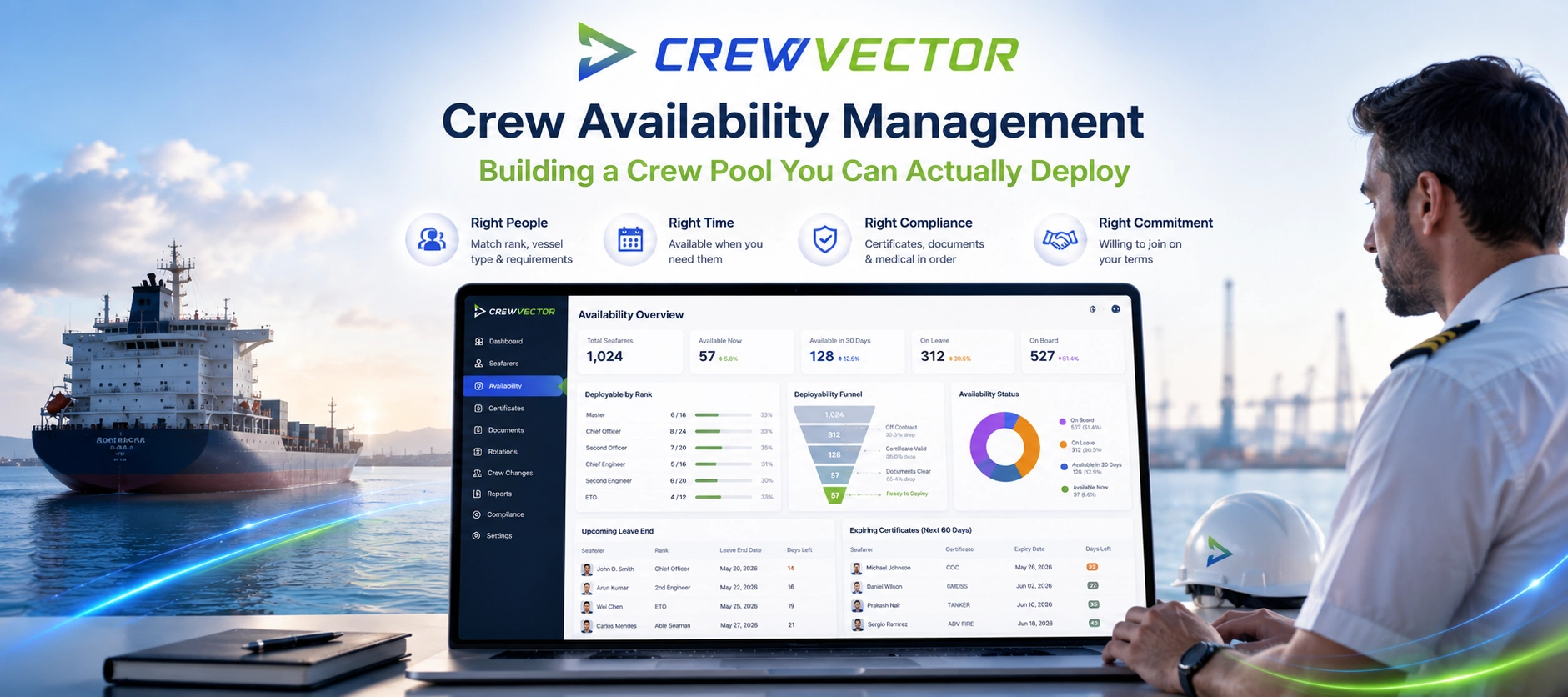
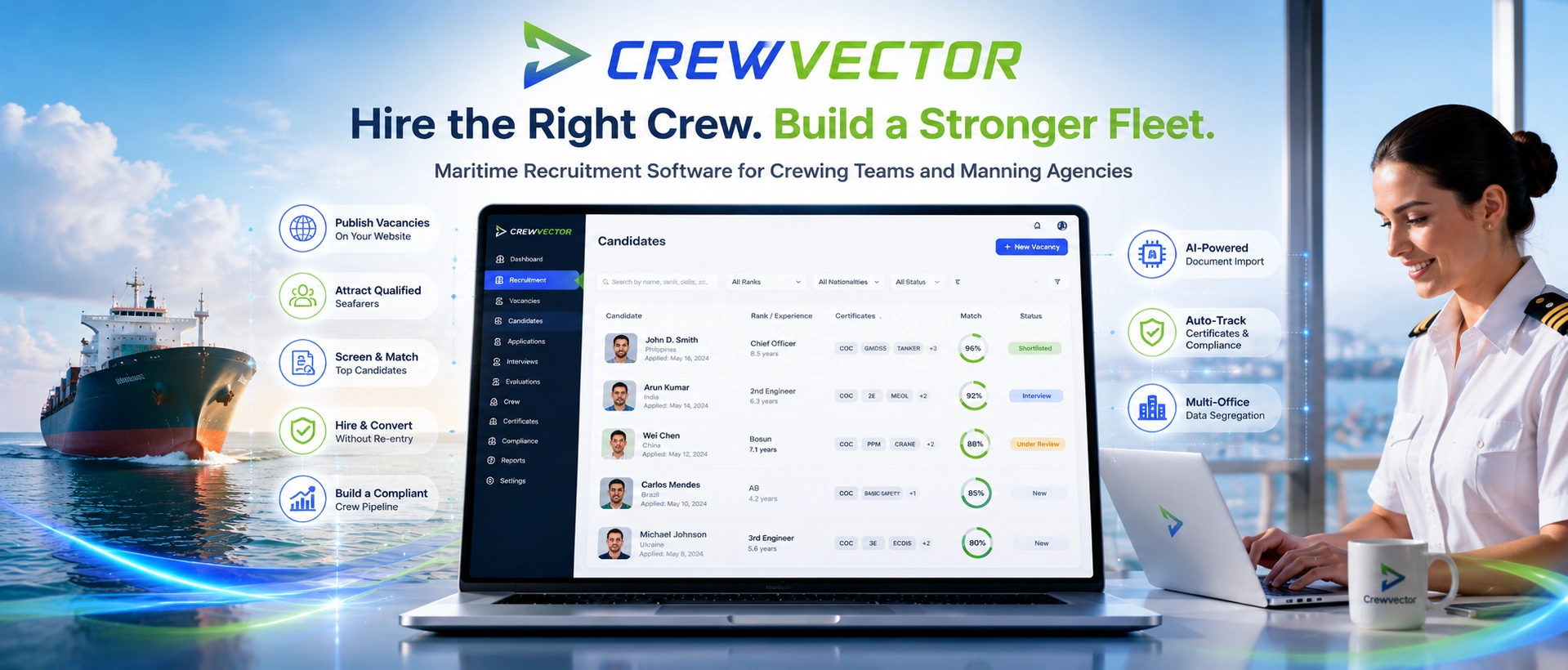
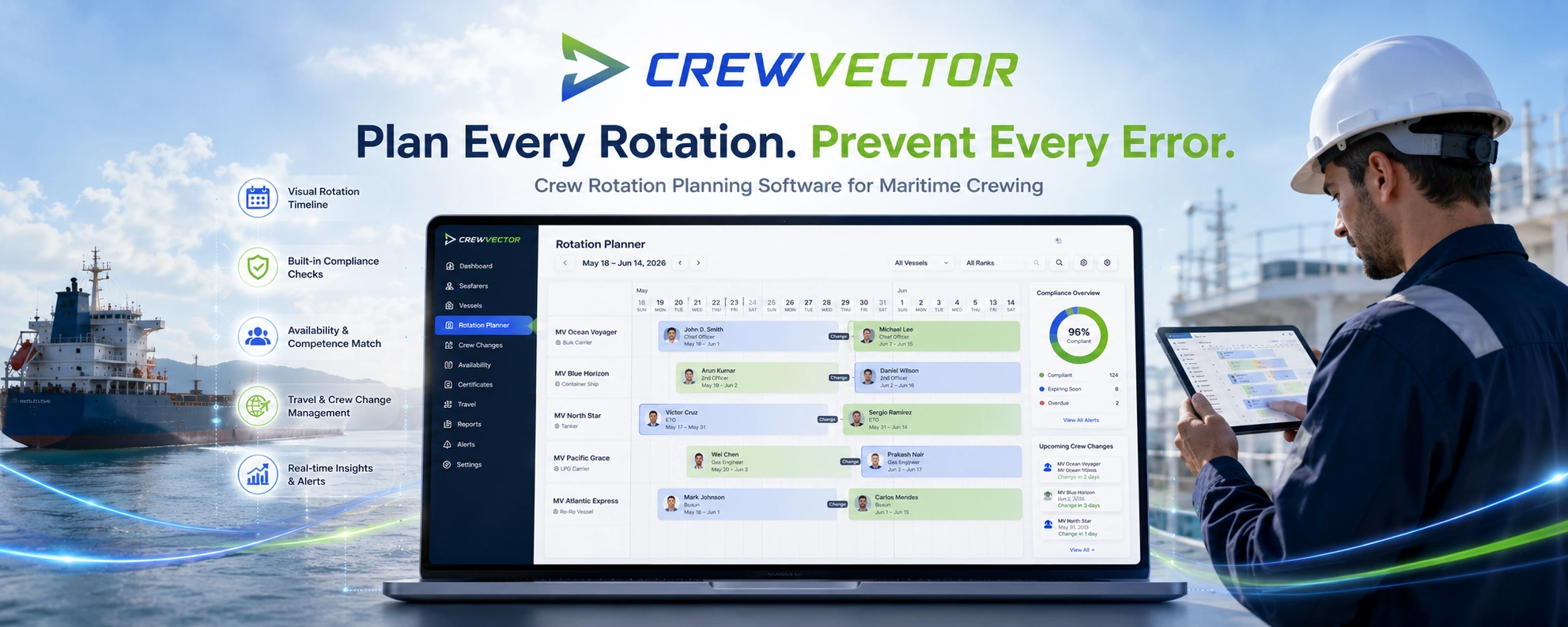
A crewing desk that has run merchant fleet rotations for years can look at offshore work and assume it's the same job with different vessels. The compliance core looks familiar, the ranks rhyme, and the seafarers hold STCW like everyone else. That assumption holds until the first short-notice call-off lands and the planning-first machinery that works beautifully for deep-sea rotations has no fast way to answer the only question that matters: who can I put on that asset by Thursday, fully validated and able to travel?
Offshore crewing is not deep-sea crewing scaled or relabelled. It runs on a different operational tempo, a deeper and more fragmented certificate stack, and a demand pattern that resists the long planning horizon merchant crewing is built around. The places where the two diverge are specific, and each one carries a process and tooling consequence. This breakdown stays on those divergences — and on where each model fails when it's applied to the wrong fleet.
Rotations: fixed deep-sea cycles vs offshore hitch and back-to-back
Deep-sea rotation is a long-horizon planning problem. Contracts run in months — commonly four to six on articles, with defined leave — and relief is planned against the vessel's trading pattern. You know in spring who relieves the Master in autumn, and the harder part is finding a port where a crew change is logistically and commercially feasible, not deciding when it happens. The cycle is stable enough that you can recruit against it well ahead of demand.
Offshore runs on hitches measured in weeks, not months: 2/2, 3/3, 14/14, 21/21, 28/28, often back-to-back, where two people share a single seat and swap on a fixed cadence. That cadence is set by the asset's operational tempo — a drilling campaign, a construction or installation window, a survey scope — not by a trading route. When the client's program shifts, the rotation shifts with it.
Two consequences are easy to underestimate. Back-to-back pairing creates a dependency that deep-sea relief planning doesn't have: if one half of a pair drops out, you don't need any qualified replacement, you need someone who can hold that specific seat on that cadence with the matching client approval. Short hitches also multiply crew movements per person-year. A seafarer on 28/28 generates far more mobilizations, travel bookings, medical checks, and document-validation events annually than one on a six-month article — and every one of those events is a chance for a certificate or medical to fall out of currency unnoticed.
The failure mode is applying a deep-sea planning horizon to offshore. Plan months ahead against a fixed cycle and you're flat-footed the moment a client extends a campaign by three weeks or compresses it by two.
Certification: STCW baseline vs offshore's layered client and OEM stack
For deep-sea, the certificate picture is relatively stable and internationally standardized. STCW core competencies, flag state endorsements, and vessel-type certificates — tanker dangerous-cargo endorsements for oil, chemical, or gas, for example — define a matrix that is largely fixed per rank and vessel type. Oil-major vetting and TMSA expectations add a layer on tankers, but it's a known layer that moves slowly.
Offshore vessels are still ships, so STCW still applies — but it's the floor, not the matrix. On top sit offshore-specific safety credentials, typically BOSIET, HUET, and FOET refreshers under OPITO (or GWO equivalents in offshore wind), an offshore medical that is often stricter and more frequent than a standard flag or ENG1 medical, and then client- and OEM-specific requirements that change per contract and per installation. One operator wants its own safety induction and permit-to-work tickets; another requires OEM training on a specific crane, ROV, or DP equipment suite.
The non-obvious point: the offshore certificate requirement is not fixed per rank, it's fixed per rank × client × asset. The same DPO can be fully approved for one operator's vessel and short a single ticket for another's. A flat "STCW compliant" status field is close to useless in that environment, because compliance only has meaning relative to a target contract. The requirement has to resolve against where the person is actually going, which is why offshore desks lean on certificate tracking that resolves per-contract requirement matrices rather than a single master list.
Currency cycles compound this. BOSIET and HUET sit on roughly four-year validity with shorter FOET refresher cycles, and offshore medicals often run on a tighter clock than the cadence a merchant desk is used to watching. Track offshore tickets on a deep-sea review rhythm and they lapse between checks.
Where it breaks: treating offshore certificates as a static add-on list bolted onto the STCW baseline, rather than a contract-resolved requirement set. The person clears on the master list, then fails to make the asset because a client induction was never booked.
Mobilization: planned crew change vs short-notice call-off
Deep-sea mobilization is logistics against a known clock. The vessel has an ETA at a port on a date; you build flights, visas, letters of guarantee, and joining instructions around that window. The work is real and visa or port constraints can be unforgiving, but the timing is known weeks ahead.
Offshore mobilization is frequently a call-off — a request to put a validated, available, document-ready person on an asset within days, sometimes hours. The trigger might be sickness cover, a campaign change, a weather window opening, or a sudden client requirement. The crew change itself may run by helicopter, which imports constraints merchant crewing never deals with: POB limits, body-weight and survival-suit sizing on the manifest, and HUET currency as a hard gate to board the aircraft.
The binding constraint offshore is not "is there a qualified person?" It's "is there a qualified person who is simultaneously available, medically current, holds valid offshore tickets and the specific client approval, and can travel now?" Each filter is reasonable on its own; their intersection is small, and it shrinks fast under time pressure. A name that clears the qualification check on paper can still fall off the chopper manifest on weight or an expired HUET.
A desk built only for planned crew change struggles here — not because the people lack skill, but because the data needed to answer the call-off question (availability, currency, client approval, and travel readiness, all at once) isn't held anywhere it can be resolved in one view. The answer becomes an investigation when it needs to be a lookup.
Crew pool and availability: sizing for predictable vs unpredictable demand
Deep-sea pool sizing is close to deterministic. Run a known number of vessels on a known rotation and the seagoing complement, the leave coverage, and a sensible buffer give you a pool size you can recruit toward. Attrition and relief dates are visible far enough ahead to hire against them.
Offshore pool planning is a portfolio problem, not a schedule. You're not sizing for "DPOs" in the abstract; you're sizing for DPOs approved for Client A's assets, DPOs approved for Client B's, and so on, against a demand pattern that spikes unpredictably with call-offs. Bench depth has to absorb those spikes. Idle bench costs money every day; thin bench loses contracts the moment two clients call off in the same week.
That reframes cross-qualification as a deliberate commercial lever rather than an HR nicety. A person approved across three clients is worth far more to the bench than one approved for a single operator, because they cover more of the demand distribution. Paying for an extra client induction or OEM ticket is an investment in bench flexibility — a calculation deep-sea pools rarely need to make. The trade-off is blunt: deep multi-client bench is expensive to maintain, and running it thin means turning down call-offs or buying cover from agencies at premium short-notice rates.
What this means for crewing-department processes
The two models optimize for different things. Deep-sea desk processes optimize for planning horizon and logistics — getting the right person to the right port on the right date. Offshore desk processes optimize for speed of validated matching under uncertainty — proving, quickly, that a specific person can legally and physically be on a specific asset very soon.
A few practical implications follow:
Run the planned-rotation workflow and the call-off workflow as separate processes. Forcing short-notice mobilizations through a planning-first pipeline is where most cross-over operations stumble.
Treat client approvals as first-class data, not free-text notes. If approval status can't be filtered and resolved against a target asset, the call-off question stays an investigation.
Pre-validate the bench against likely client requirements before demand arrives, so a call-off becomes a lookup over an already-qualified pool rather than a scramble to confirm currency and approvals under the clock.
Watch offshore certificate and medical currency on an offshore cadence, not a merchant-fleet one — the validity clocks are shorter and the consequences of a lapse are immediate at the helideck.
The data model is the quiet decider. Offshore needs certificate tracking that resolves per-contract requirement matrices, availability that is close to real time, and client approval as a queryable field. Bolt a handful of extra certificate types onto a deep-sea system while keeping its planning-first workflow and it works — right up to the first short-notice call-off, when it can't produce a validated name fast enough.
This is the gap a few crew management platforms are built to close. Crewvector, for instance, holds both deep-sea rotation profiles and offshore hitch and call-off profiles in one system, with certificate matrices that resolve against vessel- and client-specific requirements and an owner-facing view through its shipowner portal. Tooling doesn't remove the need for bench planning or cross-qualification investment — those stay judgment calls for the crewing desk — but it can shorten the distance between a call-off and a validated, document-ready name.
FAQ
Can a deep-sea crewing process be reused for offshore?
Partly. The compliance core — STCW tracking, document storage, sea-service records, payroll preparation — transfers cleanly. The planning-first workflow does not, because it assumes a long horizon and predictable relief dates that offshore call-offs don't provide. Plan to run a parallel rapid-matching process for short-notice mobilization rather than stretching the rotation workflow to cover it.
What offshore certificates sit on top of STCW?
Typically OPITO-accredited safety training — BOSIET, HUET, and FOET refreshers — plus an offshore medical (OGUK/Energy Institute-style) that is often stricter than a standard flag medical. Above that sit client- and OEM-specific requirements: operator safety inductions, permit-to-work tickets, and equipment-specific training. The exact stack changes per client and per installation, so it has to be resolved against the target contract rather than treated as one fixed list.
How much larger does an offshore crew pool need to be?
There's no clean multiplier. Deep-sea pool size follows rotation math; offshore size follows demand variability and how fragmented client qualification requirements are. A pool serving several operators with overlapping but non-identical approval requirements needs more bench depth — and more multi-client-qualified people — than rotation math alone would suggest.
Why are offshore mobilizations so often short-notice?
Offshore demand tracks asset tempo: campaign changes, weather windows, equipment readiness, and sickness cover all move on short timelines the crewing desk doesn't control. Helicopter logistics add a second layer of constraint — POB and weight limits, plus HUET currency as a hard boarding gate — so even a fast qualification match can still be delayed by the means of getting the person offshore.