24.06.2026
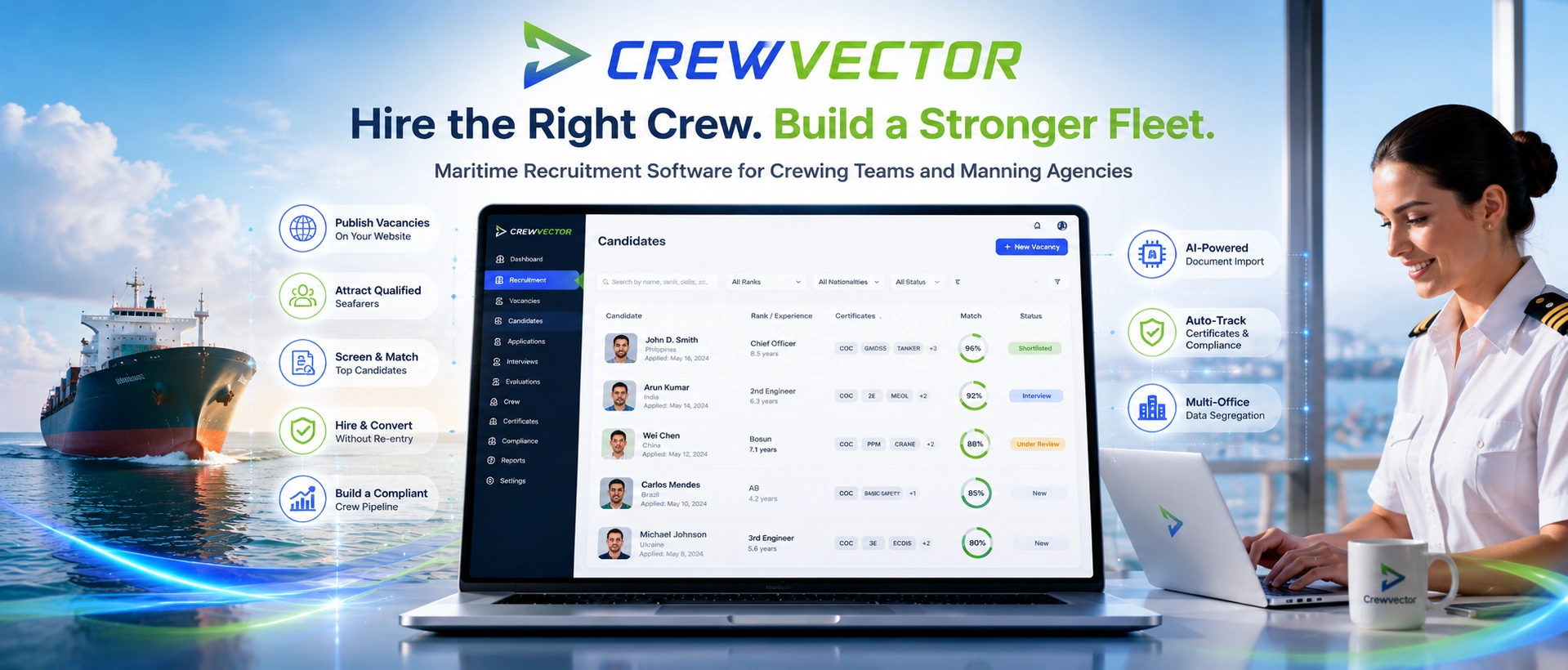
Maritime Recruitment Software for Crewing Teams
Maritime recruitment software for crewing teams and manning agencies. Publish vacancies, screen seafarer applications, and convert candidates into ready crew in one platform.

26.06.2026
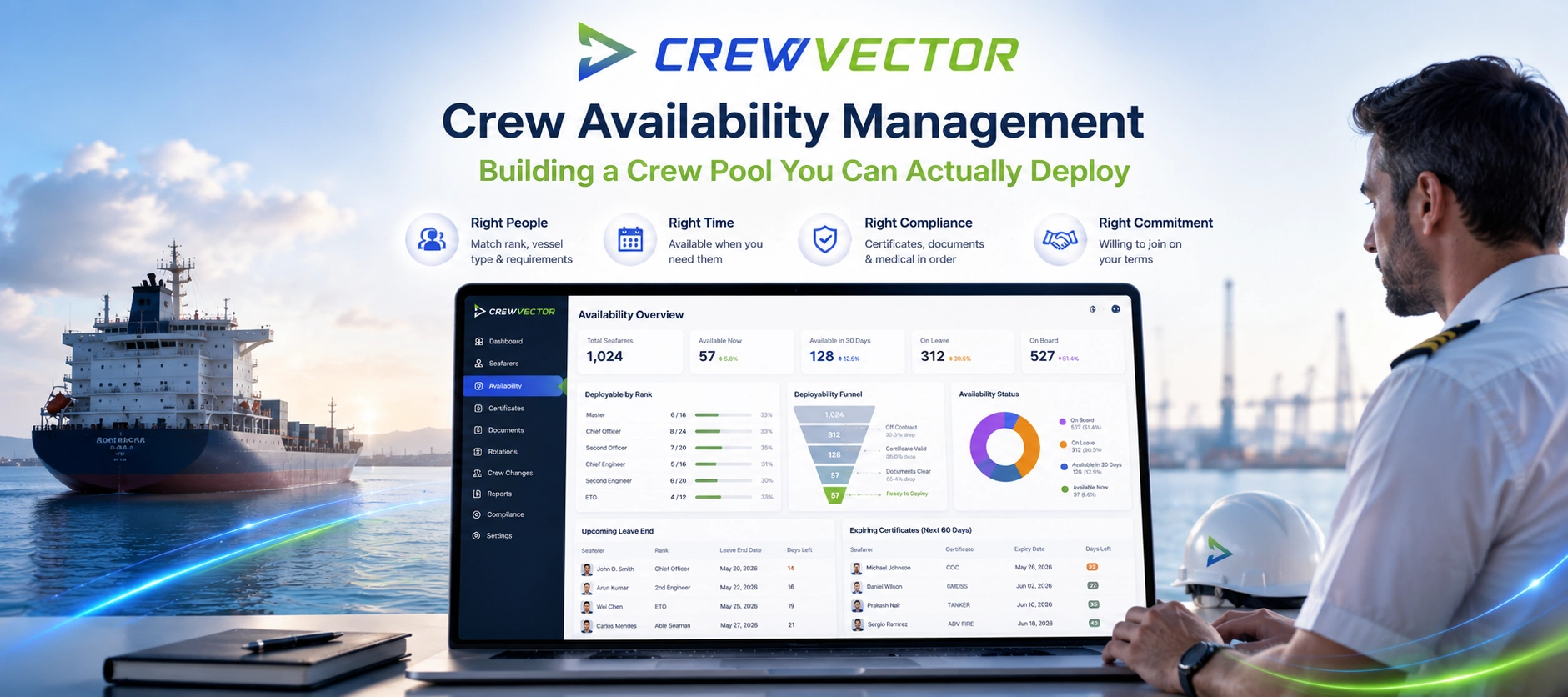
Most crewing desks know the feeling. Management asks how staffing is looking, you point at a database with a thousand names, and everyone relaxes — until a relief falls through at short notice and that thousand suddenly produces nobody who can sail the right rank, on the right vessel type, on the right dates, with papers in order. The number on the screen and the number you can put on a plane are rarely the same. Crew availability management is the discipline of closing that gap: keeping a pool that reflects who is genuinely deployable, not who once worked for you.
A crew database is a historical record. It tells you who has sailed for you, what they last held, and what their paperwork looked like the day someone entered it. Availability is a different question entirely — it is a real-time, assignment-specific query. Treating the two as the same is how desks end up surprised by a vacancy they technically had coverage for.
The collapse from nominal to deployable is multiplicative, and that is why it is so brutal. Filter a thousand seafarers down to one rank, and you might keep two hundred. Restrict to those off a vessel right now, and you are at sixty. Require a valid certificate set for the specific vessel type and flag, and you are at twenty-five. Strip out anyone whose documents won't clear in time for the crew change, and you have a dozen. Ask which of those will actually accept the contract on those dates, and you are back to the handful every coordinator quietly expects. Each filter is reasonable on its own; stacked, they explain why a pool that looks generous on a dashboard feels empty at 2 a.m.
The practical takeaway is to stop reading database size as a capacity signal. A useful availability picture is not "how many seafarers do we have" but "how many can fill this seat, on these dates, without a compliance or document blocker." Desks that internalise this stop being reassured by headcount and start being reassured by the depth of deployable coverage per rank and vessel type — which is usually far thinner than the headline suggests.
Deployability is an AND condition across several layers. A seafarer has to pass every one of them for the same assignment. Fail a single layer and the rest of the profile is irrelevant for that crew change, however strong it looks. The table below is the difference between what a nominal headcount assumes and what each layer actually demands.
| Layer | Nominal availability assumes | Deployable availability requires |
|---|---|---|
| Status & leave | Name is in the database | Off any current contract; leave-end date confirmed and not yet passed |
| Certificates & competency | Certificate exists in the file | Valid for this rank, vessel type, flag and owner/charterer — for the full time aboard |
| Visa, medical, documents | Documents were captured at some point | Complete and current, with visa and medical lead times cleared before the crew change |
| Willingness | Person sailed for us before | Confirmed acceptance of this contract, dates and terms |
Every row is a filter, and they stack multiplicatively. A seafarer only counts as available when all four resolve in your favour for the same seat.
Status is the first gate. Someone currently onboard is not available; someone on leave is available only from their leave-end date forward. The trap is that leave-end dates drift constantly and quietly. A seafarer requests an extension, a family matter pushes a return, a planned relief slips a port. If status fields are only set once and never revisited, the pool fills with phantom availability — an "available from 15 March" that was entered three months ago and no longer reflects anything real.
The more disciplined desks treat the leave-end date as a date that needs reconfirming as it approaches, not a fact entered once. The closer a return date gets, the more it is worth a direct check, because a relief plan built on an unconfirmed return is the most common way a "covered" vacancy turns into a scramble.
A seafarer can be off leave and keen, and still be blocked by certification. The subtlety practitioners know and outsiders miss is that validity is assignment-specific, not absolute. It is never just "does the certificate exist." It is whether the certificate set is valid for this rank, this vessel type, this flag, and this owner or charterer.
A Master valid on a bulk carrier under one flag is not automatically deployable to a chemical tanker under another — that move can require dangerous-cargo or tanker endorsements, additional flag state endorsements, and acceptance under the charterer's vetting regime. Expiry timing compounds this. You cannot send someone whose STCW certificate or endorsement lapses three weeks into a four-month contract, so the real test is not "valid today" but "valid for the full intended period aboard." A competency matrix that checks the full required set against the specific vacancy — rather than a flat list of certificates a person happens to hold — is what separates a list from a usable availability picture.
With status clear and certificates valid, the document set still has to be complete and current for the specific crew change. Medical certificate validity, visa requirements for the embarkation port, seaman's book, vaccination and yellow-fever requirements, and the eventual OK-to-Board all have to line up. Like certificates, this is an AND condition — any single missing or expiring item makes the person undeployable for that change, even if everything else is perfect.
Visas are the classic silent blocker. A seafarer who is "available" on paper but needs a visa appointment with a multi-week lead time is not deployable for a crew change that lands inside that window, and the gap usually only surfaces once travel is being arranged — far too late. The desks that avoid this read document readiness backwards from the crew change date and treat visa and medical lead times as part of the availability question itself, not as a logistics afterthought.
The last layer is the one that rarely makes it into a system, because it lives in phone calls rather than fields. A fully compliant seafarer still has to accept this contract, on these dates, on these terms. The person who told you last month they wanted three months off, the one holding out for a particular vessel or rate, the one who has already verbally committed elsewhere — all of them read as "available" if willingness is never recorded.
This is the layer that fails the 2 a.m. test. When a relief is urgent, the distance between "should be available" and "confirmed yes, mobilising" is the entire job. A pool that records confirmed, tentative, and declined status — even informally — is worth far more than a longer list where every name is an unanswered question. The cost of not recording it is paid in wasted calls down a list of people who were never going to say yes.
Availability has no meaning in the abstract. It only matters against a specific vacancy with a rank, a vessel, a date, and a location. The right question is never "who is available?" but "who is deployable for this seat?" — which reframes the pool as a query you run, not a list you scan.
Relief planning makes this concrete. You work backwards from the crew change date through travel and visa lead times to a must-confirm-by date, and the pool has to be filterable against that. When availability cannot be queried against an open vacancy, coordinators fall back on scanning manually or relying on memory, and that is exactly where good candidates get missed and double-bookings happen. Tying the availability picture directly to vacancy and relief planning — so an open seat surfaces the seafarers who clear every layer for it — is what turns a pool from a reference list into an operational tool. This connection between a live availability view and open vacancies and rotation planning is where most of the time saving in day-to-day crewing actually comes from.
Pools rarely fail loudly. They go stale quietly, and the headcount keeps everyone comfortable while the deployable count erodes underneath. Four leaks account for most of it.
Stale statuses. Fields set once and never revisited are the largest source of phantom availability — leave-end dates that have already passed, "available" flags left on after someone took a contract elsewhere, returns that slipped without being updated. The database looks full; the reality has moved on.
Manual updates. When availability lives in a personal spreadsheet or someone's head, it only updates when that person remembers. Reality changes faster than manual re-entry ever keeps up, so the data is structurally behind. The more crew changes a desk handles, the wider that lag gets.
Single-coordinator knowledge. "Ask Maria, she knows who's available" is a failure mode dressed up as efficiency. A pool only one person can read disappears the moment that person is on leave, off sick, or leaves the company, and the institutional memory walks out with them. If availability cannot survive a coordinator's absence, it is not a system — it is a dependency.
No intake cadence. Pools shrink through ordinary attrition: seafarers retire, move to competitors, or let certificates lapse. Without regular replenishment, the deployable count quietly falls even as the database count stays flat or grows. A pool that is never topped up is a depreciating asset, and the depreciation is invisible until you need depth you no longer have.
Keeping a pool deployable is a maintenance discipline, not a one-off cleanup. Four habits do most of the work.
A practical checklist for an availability review:
Availability management is not one discipline. Offshore and deep-sea operate on different clocks and different certificate stacks, and a pool tuned for one will fail for the other.
Offshore runs on short notice. OSVs, DP vessels, and wind-farm support work routinely call off crew with days of warning, not the weeks a deep-sea rotation allows. The pool has to be deployable now, which means willingness and document readiness carry far more weight — there is no time to start a visa or chase a medical. Hitch cadence adds another constraint: back-to-back and even-time rotations make availability tightly periodic, and you are often planning a repeating hitch, sometimes with a fixed back-to-back partner, rather than a single open-ended contract.
Offshore also carries a certificate layer deep-sea does not. On top of STCW, you are dealing with survival and emergency training such as BOSIET, HUET, and FOET, offshore medicals to the relevant standard, and client- or installation-specific inductions and requirements. A DP officer needs valid DP certification and logged sea time to match. A seafarer who is fully deployable deep-sea is not automatically deployable offshore, and treating the two pools as interchangeable is a reliable way to discover a gap at the worst moment. Because notice is short and the certificate requirements are narrow, offshore needs more genuinely-ready people per seat — a thin offshore pool breaks at the first sickness call-off.
Deep-sea trades the short-notice pressure for a longer planning horizon and more predictable rotation, but it adds its own complexity: visa and flag requirements that shift with trading patterns, and relief that has to align with the vessel's port rotation. You cannot always change crew where you would like to, so deep-sea availability is as much about timing the relief to a port as it is about who is free.
A live availability view that holds statuses, leave dates, and a certificate and competency matrix for each seafarer — and lets you check validity against a specific vacancy — is what makes either pool usable under pressure. Tools built for maritime crewing, such as the Seafarer Manager used by crewing teams, exist to hold that picture in one place rather than across spreadsheets and individual coordinators' memory. Where MLC time-aboard or leave entitlement matters, it is worth treating it as a planning input that shapes when a seafarer should rotate, separate from the question of whether the system itself is the system of record for hours.
What does "available" actually mean for a seafarer? Available means deployable for a specific assignment, not simply present in the database. It requires status clear of any current contract, leave ended (or ending in time), certificates and competencies valid for the rank, vessel type and flag, a complete and current document set, and confirmed willingness to take the contract. A seafarer missing any one of these is not available for that crew change, regardless of how strong the rest of the profile looks.
How is a crew pool different from a crew database? A database is a historical record of everyone who has sailed for you; a pool is the subset you can actively deploy. The database answers "who do we know," while the pool answers "who can sail now." A pool is maintained against current status, validity, and willingness, which is exactly the information a static database tends to let go stale.
How far ahead can you realistically forecast crew availability? Deep-sea rotation lets you plan reliefs weeks to a couple of months out, anchored to known leave-end dates and the vessel's port rotation. Offshore is far shorter — often days — because call-offs and sickness relief move quickly. In both cases the forecast is only as good as how recently leave-end dates were reconfirmed, since an unconfirmed return date is a forecast built on a guess.
How does certificate expiry affect who's actually available? A certificate has to be valid for the entire intended time aboard, not just on the embarkation date. A seafarer whose endorsement lapses partway through a contract is not deployable for it, which removes people from the pool who otherwise look ready. This is why availability checks have to test expiry against the contract length and the specific vessel and flag requirements, not just confirm a certificate exists.
How do you stop a crew pool from going stale? Assign clear ownership of status accuracy, reconfirm leave-end dates as they approach rather than once, and drive status changes from real events like sign-off and certificate renewal instead of manual re-entry. Replenish steadily from the candidate pipeline through structured intake so attrition does not quietly thin the deployable count. Above all, keep the pool readable by more than one person, so it survives a coordinator's absence.
24.06.2026
Maritime recruitment software for crewing teams and manning agencies. Publish vacancies, screen seafarer applications, and convert candidates into ready crew in one platform.
22.06.2026
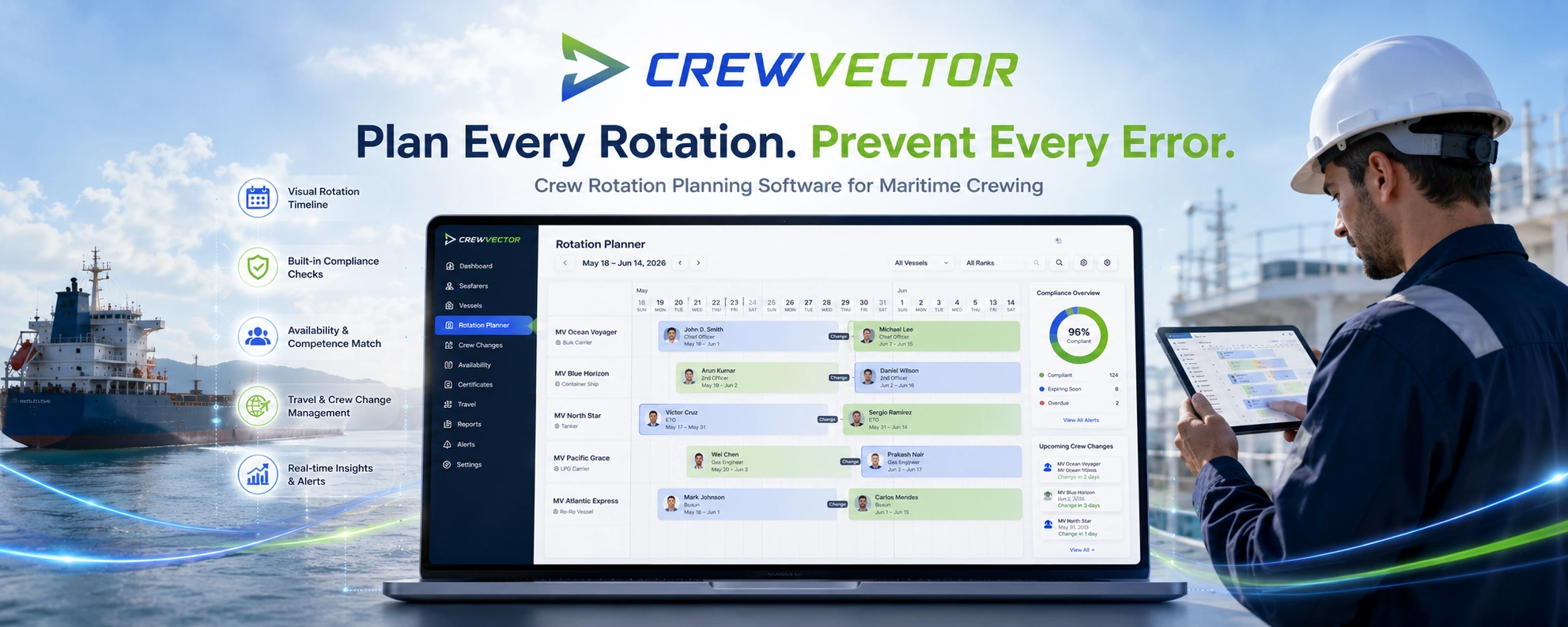
Crew rotation planning software for maritime crewing. Plan rotations, reliefs and crew changes on a visual timeline, with conflict detection and certificate checks built into every assignment.

19.06.2026
Crew document management software for maritime crewing. Track seafarer certificates, medicals, visas and expiries in one place, with AI document import, compliance checks and built-in verification.