A deep-sea rotation looks trivial on a planning board: a green bar for time aboard, a gap for leave, a fresh bar where the reliever picks up. That visual simplicity is the trap. Each bar rests on five independent variables — contract length, MLC service and rest limits, reliever lead time, certificate validity, and crew availability — and the plan holds only while all five stay aligned. Break one and the failure rarely shows on the board. It shows at the gangway on the day of the crew change, when the reliever's flag endorsement lapsed a week earlier or the only routing to the joining port was three connections he was never going to make.
So rotation is not a scheduling habit you describe as "six on, two off." It is a constraint problem you solve weeks or months ahead, and the value of a crewing desk is measured by how early it catches the collision between those constraints. The sections below take each variable in turn, with the math and the failure modes that experienced coordinators have usually been burned by at least once.
A rotation window contains far more than "6 on / 2 off"
"6 on / 2 off" is a contract shorthand, not a plan. The window a coordinator actually has to close around a single relief contains several moving parts, and the ones that cause trouble are the ones that never appear as a separate line on a Gantt chart.
| Component |
Typical planning range |
Who owns it |
Why it bites |
| Contract / SEA period |
4–9 months for officers; varies by CBA and trade |
Crew coordinator, owner rep |
The only part most plans actually track |
| Travel each way |
1–3 days; longer for remote joining ports |
Travel desk, agency |
A weekend or visa-blocked connection swallows the buffer |
| Handover overlap |
1–3 days aboard, rank-dependent |
Master / chief engineer |
Skipped under cost pressure, then blamed for the next incident |
| Documentation lead time |
Weeks to months for endorsements and visas |
Agency, crew coordinator |
Runs in parallel and is forgotten until it's late |
| Reliever's own availability |
Set by the reliever's previous contract |
Agency, crew pool |
The reliever you want is finishing another vessel |
The practical lesson is that the contract bar is the smallest part of the problem. A four-month contract with a two-day handover, two travel days each way, and a six-week endorsement renewal is not a four-month planning task — it is a task that has to start six to eight weeks before sign-on and be locked well before that. Treat the window as the contract plus its envelope, and most of the surprises move from the crew-change date back to the planning desk where they can still be solved.
How certificate expiry quietly breaks a calculated rotation
The certificate problem that wrecks rotations is not the expired document — those get caught. It is the certificate that expires inside the planned window, so the seafarer joins fully compliant and turns non-compliant mid-contract, in the middle of an ocean, where nothing can be renewed.
Consider a chief engineer assigned to a bulk carrier on a four-month contract, planned to sign off in mid-October. His Certificate of Competency is valid for years, but the flag-state endorsement recognising that CoC expires on the first of October — two weeks inside the window. On paper the rotation is clean. In reality the vessel's minimum safe manning document requires a properly endorsed chief engineer, and from the first of October the ship is technically deficient. The options at that point are all bad: an emergency reliever sourced in days, an expensive deviation, or a Port State Control finding waiting at the next call. None of them were necessary, because the conflict was visible the day the rotation was drawn.
The fix is to check certificates against the rotation window, not the calendar year. For every planned relief, run expiry on the joining and sign-off dates plus a buffer, across the full document set — CoC and flag endorsement, GMDSS, medical fitness, tanker or DP endorsements where the trade demands them, and the visa for the actual joining port. A certificate that expires the month after sign-off is fine; one that expires the week before is a swap you should be planning now, not a fire to fight in October.
Reliever lead time: why sourcing two weeks out produces an under-qualified replacement
The phrase "good reliefs book up early" is not a motivational line; it is a description of how a crew pool behaves. The strong masters and chief engineers — the ones with clean records, current endorsements for your flag, and the right tanker or specialised experience — are committed months ahead. Source a key rank two weeks before the crew change and you are not choosing from the pool; you are choosing from whoever is left in it.
The lead time also has a hard documentary floor that no amount of urgency removes. A reliever for a master's position may need a flag-state endorsement that takes four to eight weeks depending on the administration, a visa for the joining country that can take weeks of its own (a Schengen appointment or a US C1/D is not a same-week affair), a valid medical, and a flight routing that exists. Stack those in series and the realistic lead time for a senior officer is three to six months. That is why rotation planning for key positions sensibly begins a quarter or two ahead — not out of caution, but because the documentation chain physically cannot be compressed below a certain length.
A useful discipline is to separate the two clocks. The availability clock asks whether a suitable reliever exists and is free. The documentation clock asks whether that reliever can be made join-ready in time. A plan is only safe when both clocks finish before the crew-change date, and they have to be started independently — confirming the person does nothing if the visa won't clear.
Availability conflicts: one reliever planned against two vessels
The double-booking failure is structural, not careless, and that is why it surfaces so late. A spreadsheet stores the plan one vessel at a time. Vessel A's sheet shows a competent second engineer slotted in for a March relief; Vessel B's sheet shows the same man slotted in for an overlapping March relief. Neither sheet is wrong on its own terms. The conflict only exists across them, and nobody is looking at the person across both vessels until the agency tries to issue two sets of tickets for the same week.
The deeper issue is that crew planning is usually built around vessels while the constraint that breaks is attached to people. A reliever is a single resource that can be in one place at a time; a vessel-centric view cannot see when that resource is promised twice. The same blind spot hides the near-misses: the reliever who is technically free but is finishing a contract on another ship two days before he is meant to join yours, with no allowance for travel or a day's rest.
Catching this requires a person-centric check layered over the vessel plans — a view that asks, for each named seafarer, where else they are committed in the same window. On spreadsheets that reconciliation is manual and usually skipped until it is too late. The conflict is always detectable in principle; the question is whether anything in the workflow is actually looking for it before the crew change.
MLC limits as hard planning constraints, not paperwork
Two distinct MLC limits act as boundaries on any rotation, and they answer different questions. Conflating them is a common source of error, so it is worth keeping them separate on the planning desk.
The first is the cap on continuous service. The MLC links a repatriation entitlement — service before repatriation must be less than twelve months — with a minimum annual leave of 2.5 days per month of employment, and read together these point to a maximum continuous period aboard of roughly eleven months. That eleven-month figure is a derived ceiling, not a target, and many flag states and collective bargaining agreements set shorter limits, commonly six to nine months for merchant officers. For planning, the rule is simple: confirm the limit that applies to your flag and CBA, then treat it as the hard outer edge of any back-to-back arrangement. A delayed relief that pushes a seafarer toward that edge is no longer just a logistics problem; it is a compliance exposure.
The second is the rest-hour minimum, and it governs fatigue rather than tour length. Under MLC Standard A2.3, where the chosen basis is minimum hours of rest, a seafarer must receive at least ten hours of rest in any 24-hour period and 77 hours in any seven-day period, with rest divided into no more than two periods, one of them at least six hours. These minimums are checked actively by flag administrations and Port State Control, and they connect directly to manning levels: a rotation that leaves a vessel short-handed forces the remaining crew into rest-hour breaches, which is how a planning gap becomes a detainable deficiency.
STCW sits alongside this and is frequently confused with it. STCW is a separate convention governing training, certification and watchkeeping; its watchkeeping rest provisions (in the Manila Amendments) were harmonised to the same numerical figures as the MLC but apply specifically to watchkeeping personnel and exist to keep a watch safe rather than to protect labour rights. Both apply at once. The practical takeaway is that rest hours are a manning input — if a planned rotation cannot be worked within ten and 77, the rotation is wrong, not the regulation.
Scenario planning before a single itinerary change cascades
Deep-sea schedules move. A charter changes, a port rotation reshuffles, a vessel is fixed for a different trade, and the crew-change port you planned around is suddenly three weeks earlier or a continent away. The cost of contingency is almost entirely a function of when you build it: cheap before the itinerary shifts, expensive after, because by then the flights are booked, the visa was for the wrong country, and the reliever's documentation was timed to the old date.
Effective scenario planning is selective. Trying to hedge every crew change wastes effort; the skill is identifying the two or three upcoming reliefs most exposed to a schedule slip — typically those with a key rank, a tight documentation chain, or a joining port that is visa-sensitive or remote — and pre-clearing a fallback for each. That means a named backup reliever held in reserve, documentation started early enough to survive a date moving forward, and a clear answer to the question "if this port changes, where does the crew change happen instead?" One unanswered itinerary change should never be able to cascade into a manning gap; if it can, the plan had no slack built into the right places.
Rotation planning checklist
Run this against every planned relief before it is treated as confirmed:
- Contract dates, leave entitlement, and the applicable flag/CBA continuous-service limit are recorded for the seafarer.
- Travel days each way and a 1–3 day handover overlap are built into the window, not assumed away.
- Every certificate — CoC, flag endorsement, GMDSS, medical, trade-specific endorsements — is checked for expiry against the sign-off date plus buffer.
- The joining-port visa is valid or its processing time fits the lead time.
- Key-rank reliefs were sourced 3–6 months out; documentation and availability clocks are tracked separately.
- The reliever is checked across all vessels for the same window — no double-booking, no back-to-back with zero travel allowance.
- The rotation can be worked within MLC rest minimums (10 in 24, 77 in 7) at planned manning.
- The two or three most schedule-exposed changes have a named backup and a contingency joining port.
A relief that clears all eight is a plan. A relief missing any one of them is a date on a board that the crew change has not yet agreed to.
How a crew management system surfaces these conflicts early
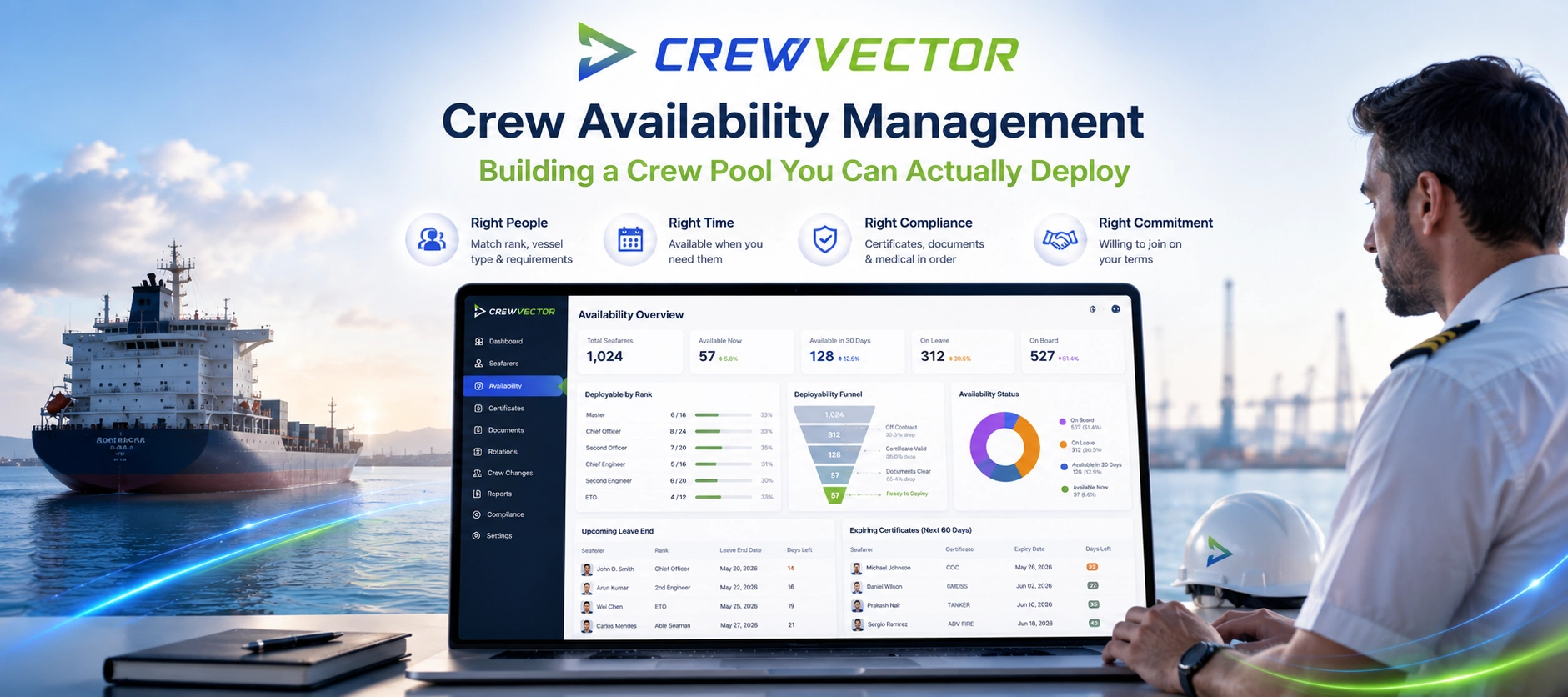
Every failure above is detectable in advance; the recurring problem is that spreadsheets store the plan in a shape that hides the collision until the crew-change date. This is the specific job of a crew management system. A platform such as Crewvector holds rotations, reliever availability, and certificate validity on one schedule, so a double-booking across two vessels, an endorsement expiring inside a window, or a vacancy with no confirmed reliever surfaces during planning rather than at the gangway. The Planning module handles conflict detection and availability and vacancy visibility across the fleet, while the Seafarer Manager module tracks certificate and endorsement expiry against planned dates. None of that replaces a coordinator's judgement on lead times or flag-specific limits — it removes the manual reconciliation that is the reason these conflicts are usually found too late.
FAQ
How far ahead should I plan a relief for a key rank?
For masters and chief engineers, three to six months is realistic, because the documentation chain — flag-state endorsement, visa, medical, flights — runs in series and cannot be compressed below a certain length. The reliever you actually want is also committed early, so late sourcing both raises risk and lowers the quality of who is available.
What is the maximum time a seafarer can stay aboard?
The MLC links a repatriation entitlement of less than twelve months with minimum annual leave, which points to a maximum continuous period of roughly eleven months — but this is a derived ceiling, and many flags and CBAs set shorter limits, commonly six to nine months for officers. Confirm the limit that applies to your flag and agreement and treat it as the hard edge of any back-to-back plan.
Are MLC and STCW rest hours the same thing?
The numbers were harmonised — ten hours of rest in any 24-hour period and 77 in any seven-day period — but the instruments are distinct. MLC Standard A2.3 protects all seafarers against fatigue as a labour standard; STCW's watchkeeping rest provisions apply to watchkeeping personnel and exist to keep a watch safe. Both apply at once, and both are checked by Port State Control.
Why does a certificate that is "still valid" cause a problem?
Because validity is a date, and the date that matters is the sign-off date, not today. A certificate or endorsement that expires inside the planned window means the seafarer joins compliant and turns non-compliant at sea, where renewal is impossible — forcing an emergency swap, a deviation, or a PSC finding. Check expiry against the window, not the calendar.
How do double-bookings happen if everything is planned?
Because plans are usually stored one vessel at a time, and a reliever booked against two vessels is invisible on either vessel's own sheet. The conflict only exists across them, so it surfaces when the agency tries to issue two tickets for the same week. Detection requires a person-centric view layered over the vessel plans.
What should I do when the vessel schedule changes?
Identify in advance the two or three crew changes most exposed to a slip — key ranks, tight documentation, visa-sensitive or remote ports — and pre-clear a backup reliever and an alternative joining port for each. Contingency built before an itinerary moves is cheap; contingency improvised after it moves is expensive and often too late.
Regulatory limits described here reflect MLC 2006 and STCW provisions as generally implemented; exact figures vary by flag state and collective agreement. Confirm current requirements with your flag administration before finalising any rotation.