Hiring and mobilizing seafarers moves fast when vessels are trading, crew changes shift, and documents expire on different clocks. An online seafarer application system brings candidate intake into one secure place, turning scattered messages, PDFs, and spreadsheets into a structured pipeline that crewing teams can trust.
A strong intake portal does more than collect a CV. It keeps data consistent, makes documents usable, and creates a clear line from application to shortlisting, planning, assignment, and payroll.
What an online seafarer application system solves
Traditional candidate intake often arrives through email threads, messaging apps, and forwarded files. Information gets duplicated, document versions get mixed, and it becomes hard to answer basic questions quickly: Who is available for a given vessel? Which certificates are valid? Who has sailed with this owner before?
A purpose-built online portal reduces time spent retyping, chasing missing fields, and comparing candidates across multiple sources. It also supports a professional, modern candidate experience that helps attract and retain talent.
A capable system treats the application as the start of a long operational record, not a one-time form. It should capture identity, sea service, competencies, and documentation in ways that remain searchable and reportable months later.
After that foundation is in place, the features that most teams value tend to be practical and repeatable:
- Fast application submission
- Mobile-friendly forms
- Document uploads with clear naming
- Duplicate detection
- Status tracking and audit trail
- Structured data capture: ranks, vessel types, experience, availability, wages, visas
- Document lifecycle: expiry monitoring, renewals, missing document alerts
- Communication tools: email templates, messaging integration, interview notes
- Shortlisting support: filters, saved searches, comparison views
The seafarer experience: simple, respectful, and clear
The intake portal should feel familiar to seafarers who may be completing an application from a phone while traveling or between contracts. Clear labels, progress indicators, and sensible validation reduce frustration and incomplete records.
It also helps when the portal explains what happens next. A candidate who can see that the application is received, under review, shortlisted, or on hold is less likely to send repeated follow-ups through multiple channels. That reduces noise for the crewing desk while improving trust.
A good portal can accept uploads for passports, seamans book, certificates, medicals, and STCW documents, while keeping the form short enough that it can be completed in one sitting. Longer history, sea service detail, and endorsements can be added over time.
The crewing desk workflow: from intake to shortlist
Once applications arrive, the internal workflow should support speed without sacrificing control. That means tools to screen quickly, standardize data, and move qualified candidates toward approval and assignment.
After the intake stream is centralized, many teams follow a repeatable flow:
- Collect structured profiles and documents through the portal.
- Validate key fields and detect duplicates.
- Classify candidates by rank, experience, and availability.
- Match candidates to open vacancies and planned reliefs.
- Keep a clear record of contact, decisions, and outcomes.
That structure makes recruitment more predictable, even when requirements change mid-process.
Data quality that supports real decisions
The value of an online application system is closely tied to data quality. Free-text fields alone are not enough. The system should encourage standard values for ranks, vessel types, certificate names, issuing countries, and date formats.
Consistency unlocks reliable searching and reporting. It also reduces the risk of sending a candidate forward with a missing endorsement, an expired medical, or a mismatched document name. When every profile follows the same logic, teams can compare candidates fairly and quickly.
Compliance, privacy, and secure storage
Crewing data includes personal identifiers, travel documents, medical certificates, and employment records. That calls for strong access controls, clear permissions, and secure hosting.
For organizations operating globally, GDPR-compliant practices and EU-based cloud hosting can simplify privacy governance. Access logs, role-based visibility, and controlled sharing with principals or shipowners help keep sensitive information protected while still supporting collaboration.
A well-designed system also supports data retention policies. Some candidates will be hired quickly, others will be held for future roles, and some will need to be removed after a defined period.
Reporting and export readiness
Recruitment decisions often require evidence: pipelines by rank, response times, source effectiveness, and document readiness. Exporting also matters when principals request specific formats, or when teams must provide candidate packs on short notice.
A structured intake portal makes reporting much more useful because the underlying data is consistent. The table below shows examples of intake data and how it becomes operational value:
| Intake data captured |
How it gets used later |
Outcome |
| Rank, vessel type experience, availability date |
Matching to vacancies and relief plans |
Faster shortlists |
| Certificate numbers and expiry dates |
Alerts, compliance checks, audit prep |
Fewer last-minute issues |
| Sea service records and employer history |
Owner reporting, performance context |
Better placement decisions |
| Wage expectation and contract preferences |
Negotiation and budgeting |
Clearer offers |
| Source channel and application timestamps |
Recruitment analytics |
Smarter sourcing |
How Crewvector supports online seafarer applications
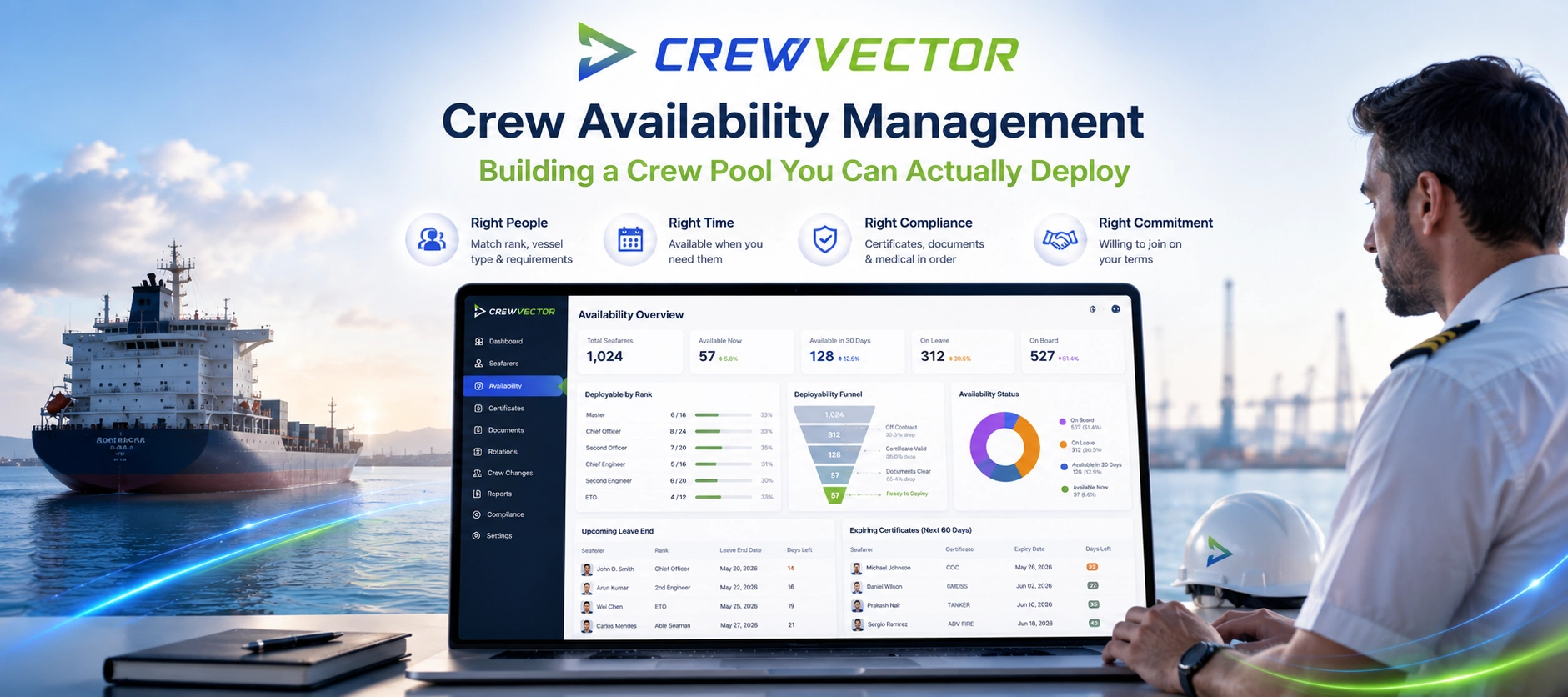
Crewvector provides a cloud-based crew management platform designed for maritime operations, with an Online Seafarer Application that feeds directly into a centralized Seafarer Manager. Instead of treating the application form as a standalone tool, it can become the intake gate to an end-to-end crewing workflow.
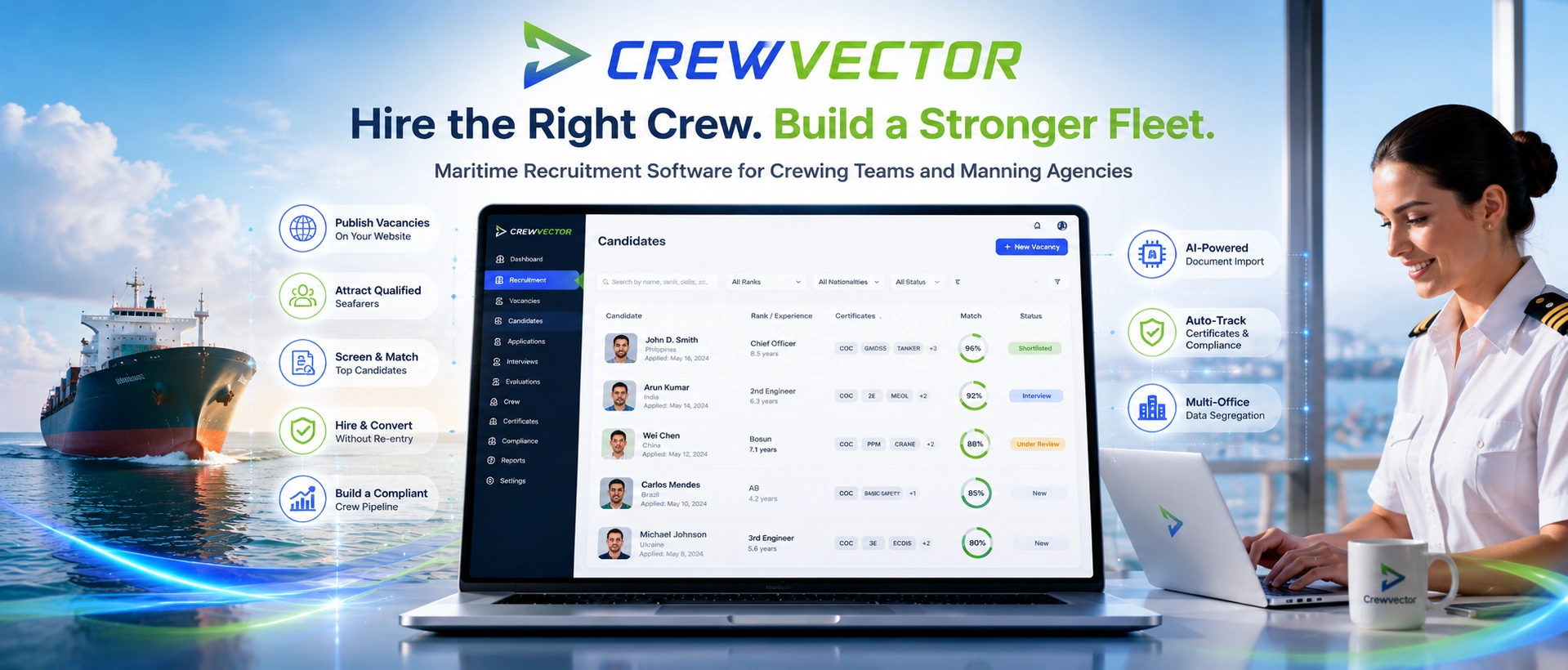
Profiles created through the portal can be enriched through AI-powered data import for existing records, reducing manual entry when migrating from legacy systems or consolidating databases. Crewing teams can publish vacancies, match candidates, and maintain communication using built-in tools that support day-to-day coordination, including direct email and WhatsApp communication.
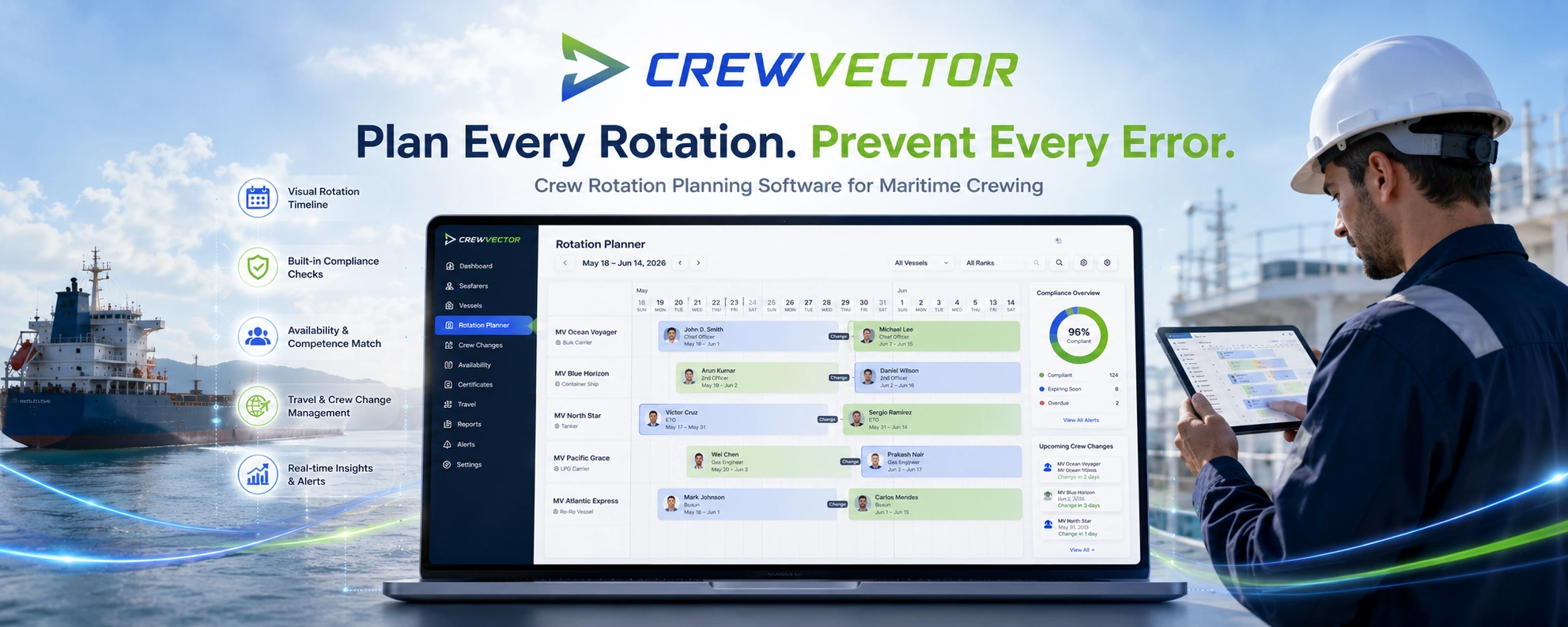
Because the platform includes planning, voyage scheduling, and finance modules (invoices, payroll, payslips), candidate intake can connect smoothly to downstream processes once a seafarer is assigned.
Portals that support collaboration with shipowners
Many shipowners and principals want visibility, but not full access to internal notes or sensitive fields. A portal approach can give controlled access to candidate shortlists, crew readiness, and analytics while keeping approvals organized.
That structure supports a cleaner rhythm between crewing agencies, ship managers, and owners: fewer attachments, fewer version conflicts, and clearer accountability when a decision is needed quickly.
Setup, migration, and adoption
A successful rollout focuses on two goals: bring existing data into the new structure, and get the team using it daily without friction. Free data migration can remove a major barrier, especially when records are spread across spreadsheets, mailboxes, and older databases.
The best results come from defining required fields, aligning rank and document libraries, and setting permissions early. From there, intake forms, automated reminders, exports, and dashboards can be tuned to the organization’s operating style.
What to look for when selecting a system
A portal that looks good on day one still needs to perform under pressure. Consider how the system handles incomplete applications, duplicate candidates, and document renewals. Ask how quickly your team can produce a shortlist with verified documents, and how easily the platform can adjust when principals require new fields or formats.
Instant access to a full-featured demo is a practical way to validate fit with real scenarios, real ranks, and real constraints before committing.
Ready to modernize candidate intake without slowing operations?
An online seafarer application system can turn candidate intake into a dependable, searchable, and secure process that supports recruitment, planning, and compliance in one continuous flow.
Crewvector offers a full-featured demo and subscription access priced per active user, making it straightforward to evaluate the portal, workflows, and reporting with your own crewing reality in mind.