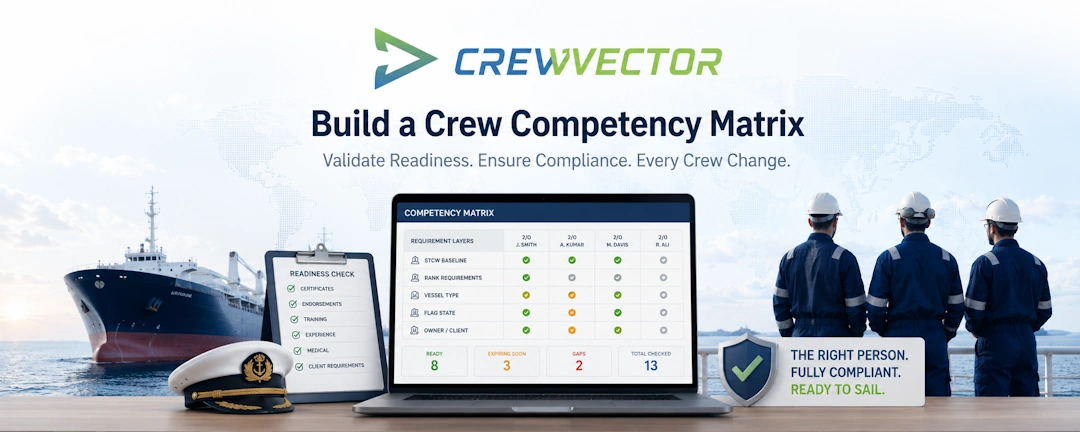
Most crewing departments already track certificates. Far fewer can answer, at the moment a candidate is proposed, whether that specific second officer meets every requirement for that specific vessel, flag, and owner — and whether he will still meet them in month three of the tour. This guide covers how to build a crew competency matrix as a layered requirements model, the ways working matrices quietly degrade, and how to use the matrix as a pre-assignment validation tool rather than a better-organized document archive.
A requirements matrix is not a certificate folder
A certificate folder answers one question: what does this seafarer hold? A certificate matrix answers a harder one: what must a seafarer hold for this rank, on this vessel, under this flag and this owner — and is the candidate compliant for the full duration of the planned tour?
The distinction is about when the check runs. Expiry alerts, the standard feature of document management, are document-centric: they fire when a certificate approaches its expiry date, whether or not anyone is about to join a vessel. A matrix is assignment-centric. It evaluates a person against a requirement set at the moment a crewing decision is being made.
Two failure cases show the difference. The first is a requirement gap: a chief officer shows all green in the document system, but the vessel is a product tanker whose owner requires an advanced oil tanker endorsement plus twelve months in rank on tankers to satisfy vetting expectations. The folder cannot flag either item, because the folder never knew the requirements existed. The second is a horizon gap: a certificate valid on embarkation day passes folder logic, but if it expires in month two of a four-month tour, the vessel will be trading with a non-compliant officer unless someone planned a renewal or an early relief. A matrix checks validity against the tour, not against the calendar date of the check.
The layers of requirements: STCW base, rank, vessel type, flag, owner
The practical way to structure vessel-specific certificate requirements is as cumulative layers. They differ in where they come from, who owns them, and how often they change — and that last property should drive how you allocate maintenance effort.
| Layer |
Typical contents |
Source |
How often it changes |
| 1. STCW baseline |
CoC, basic safety training (STCW VI/1), medical fitness (A-I/9), security training |
International convention |
Rarely — amendment cycles run in years |
| 2. Rank requirements |
GMDSS GOC for deck officers (IV/2), advanced firefighting and medical care at management level, high-voltage for certain engine departments |
STCW plus company rank profiles |
Occasionally |
| 3. Vessel type |
Tanker training (V/1-1, V/1-2), polar waters (V/4), DP certification offshore, ECDIS familiarization |
Trade and cargo profile |
When the trading pattern changes |
| 4. Flag state requirements |
Flag endorsements of CoC and GOC (I/10 recognition), flag-accepted medicals, flag seafarer documents |
Flag administration circulars |
Per circular, and whenever a vessel reflags |
| 5. Owner / charterer / client |
Drug and alcohol test validity, officer experience requirements on vetted tankers, client inductions, offshore medicals |
Management agreements, vetting regimes, client contracts |
The most volatile layer |
Three observations matter more than the table itself. The layers are cumulative, not alternatives — a requirement in layer 5 does not relax anything in layer 1. Review effort should concentrate where change actually happens: the bottom layers are stable while the top layer churns. And flag endorsements deserve their own row because they carry application lead time — an officer can hold a perfectly valid national CoC while the flag endorsement, or the receipt he is actually sailing on, is what a PSC officer will examine.
Offshore operators should expect the proportions to invert. For a DP vessel working under a client contract, the client layer — BOSIET/HUET/FOET, OEUK-type medicals, rig or site inductions, DP certification with logged sea time — often contains more line items than the regulatory layers combined. Treating offshore crewing as "deep-sea plus a couple of courses" produces a systematically under-specified matrix.
Building the matrix without ending up with one rule per seafarer
The most common modelling mistake is building outward from individuals: a requirements list per person. It works at fifty seafarers and collapses at five hundred, because every regulation change means editing hundreds of records, and nobody can tell a deliberate exception from data-entry drift.
The structure that survives is rank × vessel group, with inheritance:
- Define vessel groups by requirement profile, not just by type. "MR product tanker, Marshall Islands flag, Owner A" is a different group from the same tonnage under a different owner, because layer 5 differs.
- Build the base set once. STCW and rank requirements apply everywhere; every group inherits them rather than restating them.
- Attach deltas per layer. Each vessel group adds only what differs — the tanker endorsements, the flag documents, the owner's D&A policy.
- Handle exceptions as overlays. A dispensation or an accepted equivalency is a time-limited exception record against one seafarer, never an edit to the group rule.
- Define validity logic per requirement. Some items must merely be valid at embarkation; most should be valid through the planned tour plus a buffer. A common desk convention is buffer = contract length plus one month, because relief delays are normal, not exceptional.
- Assign an owner per layer. Crewing maintains the structure; HSEQ or marine owns regulatory content; whoever manages the owner relationship feeds layer 5. Matrices rot fastest where anyone can edit anything.
Be honest about the effort. Extracting requirements from management agreements and client contracts is slow and ambiguous, and it usually surfaces requirements nobody was actually checking. That discovery is uncomfortable — and it is precisely the point of the exercise.
Common ways a matrix silently breaks
A matrix rarely fails loudly. It drifts away from reality until an audit, a vetting inspection, or a PSC visit measures the drift. The drift has recognizable causes.
Copy-paste across vessel types. A bulk carrier matrix cloned onto newly acquired tankers is missing an entire endorsement layer. The reverse failure is subtler: requirements stricter than reality block available, fully compliant seafarers — and train coordinators to override warnings. An over-strict matrix fails differently from a lax one, but it still fails, because overrides become routine and real warnings drown.
Forgotten owner-specific documents. Vessel takeover checklists cover ISM documentation, statutory certificates, and planned maintenance. They almost never cover the crewing matrix. The new owner's training matrix or D&A policy arrives by email and lives in someone's inbox instead of in the requirement set.
Manual update lag. Flag circulars and STCW amendments do not push themselves into a spreadsheet. Without a named owner and a review cadence, the matrix reflects the rules as of whenever someone last had a quiet afternoon.
Requirements that accrete and never retire. After every audit finding something gets added; nothing is removed when the vessel leaves the trade or the contract ends. An inflated matrix generates noise, noise generates overrides, and overrides hide the warnings that matter.
Unmapped equivalencies. The same competency carries different certificate names across administrations and training providers. Without equivalency mapping the matrix throws false alarms — and false alarms teach people to ignore it, which is the quietest way a qualification validation system dies.
Pre-assignment validation: catching gaps before the crew change
The matrix earns its existence at proposal time. When a coordinator lines up a candidate for a relief, the validation should run that candidate against the full layered requirement set for that vessel and those dates — not against "are the documents valid today."
Consider the same defect discovered twice. A second engineer is proposed for a four-month tour on a Liberian-flag tanker. At the six-week pre-assignment check, the system flags his flag endorsement expiring in month two; the renewal is lodged and he joins on schedule. Now move the discovery to the day before joining, during port documentation: he either joins on a receipt that invites questions, or a replacement is sourced at agency rates with rebooked flights while the off-signer waits on board past his relief date. The certificate is identical in both stories. The timing of discovery is the entire difference in cost.
Pre-assignment validation checklist
Rank requirements met (CoC level, mandatory rank certificates)
Vessel-type set complete (tanker or gas endorsements, DP, polar, ECDIS familiarization as applicable)
Flag endorsements valid — or applications lodged with realistic lead time
Owner, charterer, and client documents current (D&A, inductions, client medical)
Experience requirements satisfied where vetting applies (time in rank, time on vessel type)
Every item valid through the planned tour plus buffer, not just at embarkation
Medical certificate valid for the tour and accepted by the flag
Visas and travel documents valid for the change port and routing
Visas are not competencies, but they gate the same decision. A complete certificate set does not help when the Schengen application lead time is longer than the days remaining to a Rotterdam crew change, which is why mature desks validate travel documents in the same pass.
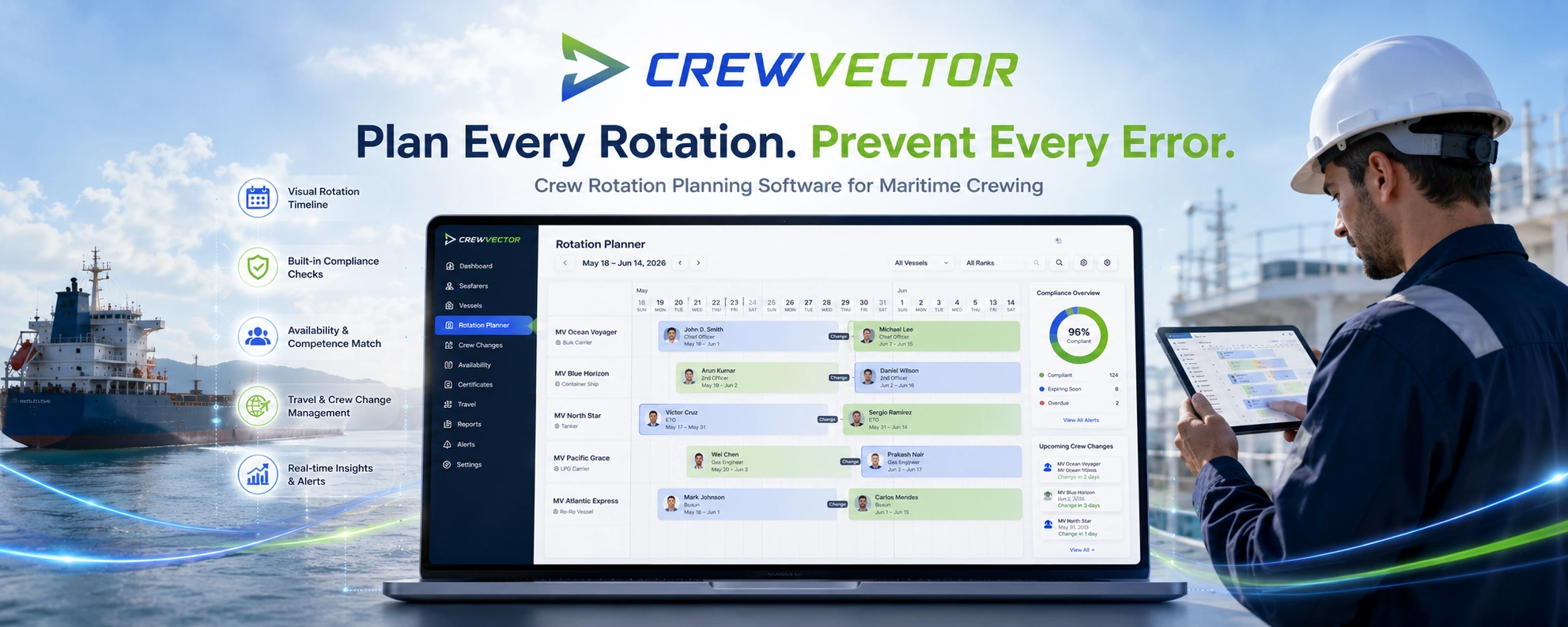
Comparing one candidate against five requirement layers across multiple planned dates is exactly the kind of check computers do better than tired humans at 17:00 on a Friday. Crewvector's Seafarer Manager supports competency matrices with automatic qualification validation against rank, vessel, and flag or owner requirements, while the Planning module runs that validation against planned embarkation dates so missing or expiring certificates surface while there is still time to act. One limitation applies to any system: validation is only as good as the data behind it. A scanned certificate entered with the wrong expiry date will pass every automated check ever run against it, so verification discipline at data entry is part of the matrix, not an optional extra.
Using the matrix for PSC and audit readiness
A PSC officer checks crew certification against the minimum safe manning document and STCW. Missing or expired CoCs, endorsements, and medical certificates sit among the deficiencies that can hold a vessel in port. The matrix's contribution to PSC inspection readiness is simple to state: nothing checked at the gangway should be news to the office.
For audits, the matrix does a second job — it is evidence of a system. ISM and flag audits, MLC inspections, and oil-major vetting all ask some version of "how do you ensure assigned crew meet requirements?" A maintained manning compliance matrix with validation records is a documented answer. "Our coordinators are experienced and check carefully" is not.
Three practices make the matrix auditable rather than merely useful. Version it: auditors ask when a requirement was added and why, and an unversioned spreadsheet cannot answer. Keep exceptions visible: a dispensation handled as a documented, expiring exception is defensible; a silently edited requirement is a finding waiting to be written. And be able to export the evidence chain — requirement, certificate, validity — per seafarer and per vessel. A matrix you cannot demonstrate on request is institutional folklore, not a compliance tool.
One limitation deserves stating plainly: the matrix proves compliance with paper requirements, not competence. Vetting and audit regimes increasingly look at appraisals, training records, and actual experience — data the matrix should point to, not replace.
FAQ
Flag requirements vs owner requirements — which takes precedence? Both apply; they are cumulative layers, not competing ones. Genuine conflicts are rare — the practical problem is gaps, where an owner requirement exists in a management agreement but never made it into the matrix.
How often should the matrix be reviewed? On three triggers: regulatory change (flag circulars, STCW amendments), events (new vessel, new owner, reflagging, a failed inspection), and a scheduled review — quarterly for the owner/client layer, less often for the stable base layers.
What offshore certificates sit beyond STCW? Typically OPITO-scheme safety training (BOSIET/HUET/FOET), client-specified medicals such as OEUK, DP certification with logged sea time, and rig or site inductions. On many offshore units this client layer is larger than the regulatory one.
Should visas and travel documents live in the competency matrix? They are not competencies, but they block the same crew change, so validate them in the same pre-assignment pass. Whether they sit inside the matrix or beside it matters less than whether the check happens before flights are booked.
Can a spreadsheet do this? For a small fleet under one flag and one owner, yes — briefly. Spreadsheets break on exactly the features that make a matrix trustworthy: versioning, equivalency mapping, per-requirement validity logic, and validation against planned dates rather than today.
Who should own the matrix? One named owner per layer, with crewing owning the overall structure. Shared ownership without boundaries is how requirements get silently edited — and how audits find the edits.
Where to start: pick one vessel and reconstruct its real requirement set from the management agreement, flag circulars, and the last vetting or PSC report — then compare it against what your desk currently checks before a crew change. The delta between those two lists is your matrix backlog, and usually your business case.