20.11.2026
What Is MLC 2006 and Why It Matters for Crewing Companies
MLC 2006 sets minimum working and living standards for seafarers. What it covers, which ships it applies to and what crewing companies should keep on record.


23.11.2026
A crewing desk manages a roster of dozens or hundreds of seafarers, and each of them carries a stack of certificates with different expiry dates. One document that runs out mid-contract can stop a crew change or lead to a Port State Control finding.
How long are STCW certificates valid for? Most Certificates of Competency and the practical safety certificates, such as Personal Survival Techniques, Fire Prevention and Fire Fighting, Proficiency in Survival Craft and Rescue Boats (PSCRB) and Advanced Fire Fighting, are valid for up to five years and then need revalidation or refresher training. The seafarer medical certificate is valid for up to two years. Elementary First Aid, PSSR and Security Awareness have no fixed STCW expiry.
This article covers what the main certificates are, how long they last, which ones need renewal, what clients and flags expect at embarkation, and how teams track expiry dates across a roster.

Image 1. ALT: Seafarer reviewing STCW certificates and training documents
What are STCW certificates? They are the documents a seafarer holds under the International Convention on Standards of Training, Certification and Watchkeeping for Seafarers (STCW), which sets the minimum training and certification standards that flag administrations apply. In practice, what are the STCW certificates a crewing team checks before an assignment? They fall into four groups: certificates of competency, certificates of proficiency, flag endorsements and the medical certificate.
A Certificate of Competency (CoC) qualifies a seafarer for a particular rank, such as master, chief engineer or officer of the watch. It is issued by a flag administration and is usually valid for up to five years.
Certificates of Proficiency (CoP) prove specific training. The most common are the basic safety training modules (Personal Survival Techniques, Fire Prevention and Fire Fighting, Elementary First Aid, Personal Safety and Social Responsibilities) and the advanced modules such as Proficiency in Survival Craft and Rescue Boats or Advanced Fire Fighting. Tanker certificates of proficiency and certain security-related certificates also fall here.
An endorsement is a flag-state recognition of a CoC issued by another administration. It cannot remain valid longer than the certificate it endorses.
The medical fitness certificate required under STCW Regulation I/9 completes the set. Strictly speaking it confirms fitness rather than training, but crewing teams check it together with the other documents whenever a seafarer is assigned.
The exact format and naming can vary by flag. The underlying requirements come from the STCW Convention and Code, as amended by the Manila Amendments. For operational purposes the useful distinction is between documents that have a fixed revalidation cycle and those that do not.
How long are STCW certificates valid for in practice? Most competency and proficiency certificates follow a five-year cycle under STCW, the medical certificate is shorter, and a few basic modules have no fixed expiry at all. So how long do STCW certificates last for a particular seafarer? The table below shows the international baseline under STCW Regulations I/9 and I/11. Flags and clients may set stricter requirements, so confirm with the relevant administration when the detail matters.
| Certificate / Document | Typical validity | What is required for renewal / revalidation |
|---|---|---|
| Certificate of Competency (CoC) | Up to 5 years | Evidence of continued competence (12 months of sea service in the last 5 years, 3 months in the last 6 months, or an approved test or course), a valid medical certificate and any required refresher training. Flag rules apply. |
| Basic Safety Training — PST and FPFF | 5 years | Approved refresher or revalidation training. Practical elements are required. |
| Proficiency in Survival Craft and Rescue Boats (PSCRB) | 5 years | Refresher training |
| Advanced Fire Fighting | 5 years | Refresher training |
| Tanker certificates of proficiency | Typically 5 years | Relevant sea service or approved course, depending on the flag |
| Medical certificate (STCW A-I/9) | Up to 2 years (1 year if under 18) | New examination by a recognised practitioner |
| Elementary First Aid, PSSR, Security Awareness | No fixed STCW expiry | Flag or company may still require updates or refreshers |
The five-year cycle is the baseline for most CoCs, and since the 2010 Manila Amendments it also applies to the practical safety modules. Only PST and FPFF from basic safety training have the mandatory five-year competence demonstration under STCW A-VI/1. Elementary First Aid and PSSR do not. Medical certificates are shorter because fitness can change. Documents without a fixed STCW expiry can still become outdated in practice if a client or flag asks for more recent training.
Revalidation and refresher are related but not identical. A CoC is usually revalidated on the basis of recent sea service: a seafarer with enough service may need no course at all, while one returning after a longer break may need a revalidation test or course. Safety certificates such as PST, FPFF, PSCRB and Advanced Fire Fighting are kept current through refresher training, which is shorter than the original course. Flag administrations set the exact thresholds. For tracking purposes the useful dates are the expiry of the current document and the date of the last approved training.
Note on PSSR from 2026: IMO Resolution MSC.560(108) added content on preventing and responding to violence and harassment. Approved PSSR courses delivered on or after 1 January 2026 must include it. Existing PSSR certificates generally remain valid, but some flags or clients may still ask for evidence of the updated content. Record the issue date so the team can answer the question if it arises.

Image 2. ALT: Certificate register on a laptop showing STCW certificate expiry dates and status
Which STCW certificates need to be renewed depends on the document, not on the fact that it was issued under STCW. Some must be revalidated every five years, some have no fixed expiry, and a third group sits in between: the convention does not require an update, but a client or flag may still ask for one.
This group covers the Certificate of Competency, the practical basic safety modules (PST and FPFF), PSCRB, Advanced Fire Fighting, and most tanker certificates of proficiency. For these, the seafarer must show within each five-year window that competence has been maintained: for a CoC mainly through recent sea service, for the safety modules through approved refresher training.
Elementary First Aid, Personal Safety and Social Responsibilities, and Security Awareness do not have a fixed expiry under STCW. Once completed, they remain on the record.
So what STCW certificates need to be updated even when the convention sets no expiry? Typical examples are PSSR after the 2026 amendments, Elementary First Aid and security awareness training. Some flags also ask for evidence of new content after an amendment, even when the original certificate remains valid.
Even modules without a fixed STCW expiry can create work if a principal’s matrix treats them as needing a five-year refresh. The practical rule is to record both the STCW baseline and any stricter client or flag requirement against the same seafarer.
“Still valid today” is often not enough. Many clients, and some flag administrations, expect a minimum remaining validity at the moment of embarkation, often three, six or twelve months depending on the principal and the rank. A certificate that expires three weeks into a six-month contract creates a mid-voyage problem even if it was valid on the joining date.
The practical check for a crewing desk is therefore against the planned tour length plus a buffer, not only against today’s date. A chief officer joining for a nine-month tour with a CoC that expires in seven months passes a six-month remaining-validity rule, yet the certificate will still lapse two months before the planned relief. The same logic applies to medical certificates and to the practical safety modules.
The flag sets the legal requirement: the certificate must be valid while the seafarer serves. Clients often add a commercial minimum in their crew matrix. Both need to be visible before a seafarer is confirmed for a vessel. A document that is valid today but expires before the planned relief is better caught at the planning stage than after tickets have been issued. On assignment, the planning view can show a warning if a document will not stay valid for the planned period.
A medical certificate that expires during a voyage can remain valid until the next port where a recognised practitioner is available, for up to three months under the convention. That provision is an emergency measure, not a planning tool. Crewing teams still treat the printed expiry as the date that matters for assignment.
Tracking is simple in principle: record the expiry date, check it against the planned tour and remind the right person in time. What changes is how well the method holds up as the roster grows.
Manual tracking in spreadsheets or shared drives works while the roster is small. As the number of seafarers and document types grows, dates get missed. One coordinator updates a spreadsheet while another works from an older copy. A certificate that was renewed last week is still shown as expired. A medical that expires during the contract is not flagged because the check was only against today’s date. Nobody gets a reminder unless someone remembers to filter the sheet, and the error rate grows with every new seafarer and document type.
Useful tracking needs to show expiry dates per seafarer and per document type, with clear reminder thresholds. Common practice is to surface documents that will expire within 90, 60 or 30 days. Linking certificates to rank and vessel requirements lets the system highlight what is missing or short for a particular assignment rather than listing every document the seafarer holds.
Whatever the tool, each certificate record should hold at least:
Making expiry visible before a seafarer is assigned is the practical goal. In a crewing system the certificate sits in the seafarer profile. The certificate matrix defines which documents each rank needs and the minimum validity at embarkation. The system shows missing and expired requirements and sends e-mail reminders before expiry, with configurable thresholds, recipients and frequency. That visibility reduces the chance of a last-minute failure or a mid-contract problem.
The same principle applies whether the team uses a dedicated system or a carefully maintained spreadsheet: the dates need to be current, the remaining validity needs to be checked against the planned tour, and the reminder needs to reach the person who can act on it before the seafarer is confirmed.
Port State Control and client audits most often ask for the current CoC, the medical certificate, and evidence that the practical safety modules have been refreshed within five years. Having those dates linked to the seafarer profile means the agency can produce the relevant documents without searching across multiple systems or older spreadsheets.

Image 3. ALT: Seafarers in life jackets during an onboard STCW safety drill
You cannot serve in a role requiring an expired certificate. An expired CoC can be revalidated with sea service or an approved course, and lapsed PST, FPFF, PSCRB or Advanced Fire Fighting need refresher training. Starting the revalidation six to twelve months before expiry avoids a break in service.
Usually not. For PST and FPFF, seafarers demonstrate continued competence every five years through a shorter refresher course with practical drills. Elementary First Aid and PSSR do not need to be repeated under STCW. A full course is normally needed only after a long break or when the flag does not accept the earlier training.
In practice, yes. It is required by STCW Regulation I/9 and checked with the other STCW documents, but it is a medical fitness certificate rather than a certificate of training. It is valid for up to two years, or one year for seafarers under 18, and many flags issue it under combined STCW and MLC 2006 rules.
20.11.2026
MLC 2006 sets minimum working and living standards for seafarers. What it covers, which ships it applies to and what crewing companies should keep on record.
18.11.2026
What PEME means, what a pre-employment medical examination for seafarers covers, who pays, what it costs and how crewing teams manage it.
26.06.2026
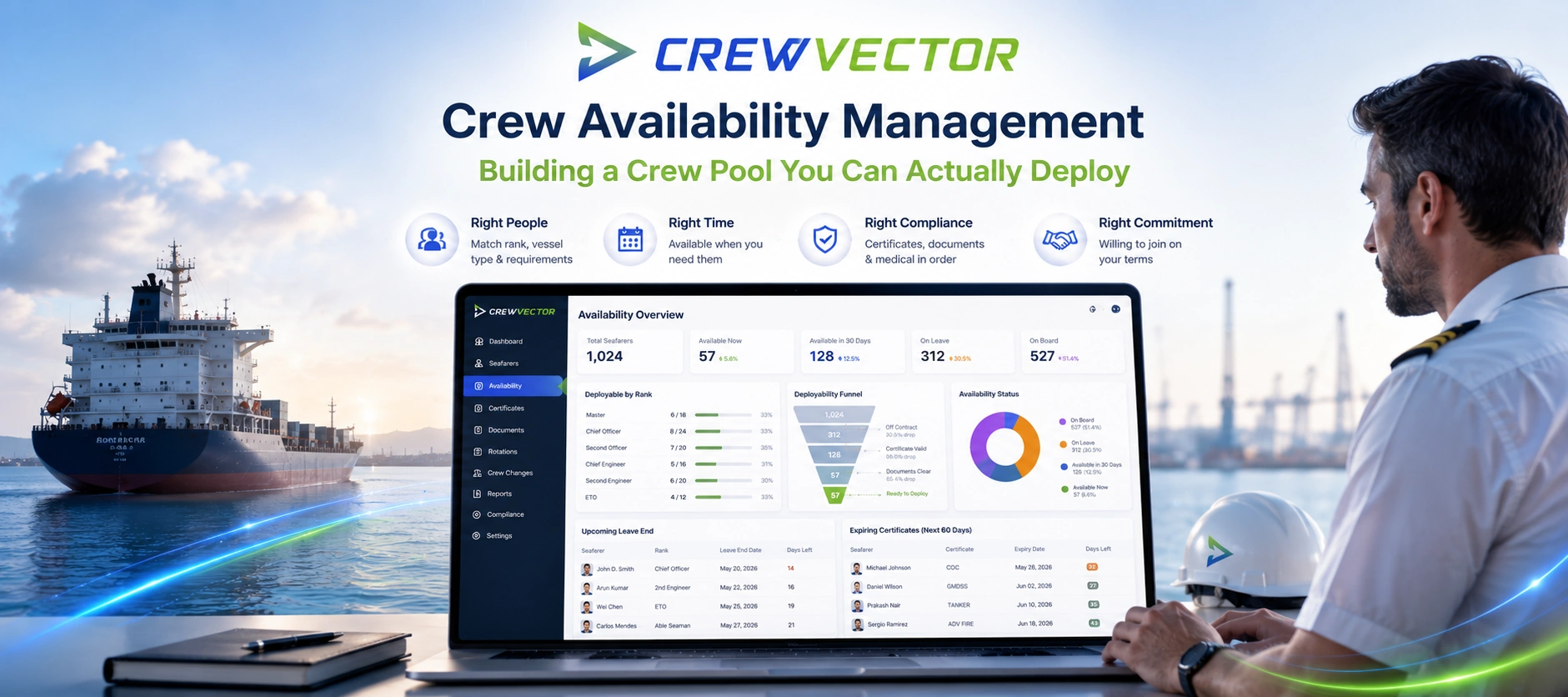
A practitioner guide to crew availability management — the gap between a seafarer being in your database and being genuinely deployable. It breaks down the layers that decide real availability (status and leave, certificate validity, visa/medical readiness, willingness), shows where pools quietly go stale, and explains how to keep one current. Includes a nominal-vs-deployable comparison table, an audit checklist, and a section on why offshore and deep-sea behave differently. Education-first, with Crewvector kept to two light contextual mentions near the end.