18.11.2026
What Is PEME for Seafarers & How Crewing Teams Manage It?
What PEME means, what a pre-employment medical examination for seafarers covers, who pays, what it costs and how crewing teams manage it.


20.11.2026
The Maritime Labour Convention 2006 is the ILO treaty that sets minimum working and living standards for seafarers. A lot of people call it the seafarers’ bill of rights. For a crewing company it is working material rather than background reading, because it shapes the employment agreement, the duties of the agency that placed the seafarer, and the records that agency is expected to hold.
Most crewing desks meet the Maritime Labour Convention in three places: the seafarer employment agreement they issue, the wage terms they pass to payroll, and the evidence they produce when a principal or port state control asks how the seafarer was recruited. This article explains what the convention covers, who it applies to, when it started and what it means for a crewing company’s daily work.

Image 1. ALT: Crew reviewing a seafarer employment agreement under MLC 2006
MLC 2006 is the Maritime Labour Convention adopted by the International Labour Organization on 23 February 2006. It consolidates dozens of earlier ILO maritime conventions into one instrument that sets minimum standards for seafarers’ employment, working conditions, accommodation and health protection, and for how those standards are enforced.
So what is MLC in maritime regulation as a whole? It sits alongside SOLAS, STCW and MARPOL as the fourth pillar of international maritime law. SOLAS covers the ship’s safety, STCW covers competence and MARPOL covers pollution, while the Maritime Labour Convention covers the people who work on the ship. The standards run across five titles: minimum requirements for seafarers to work on a ship, conditions of employment, accommodation and recreational facilities, health protection and medical care, and compliance and enforcement.
Inside those titles the convention sets floors rather than ceilings: minimum age (16, or 18 for hazardous or night work), medical fitness, the employment agreement, wages, hours of work and rest, leave, repatriation, accommodation, food and medical care. Flag states implement these floors through national law, and collective bargaining agreements often give seafarers more.
The detail sits in the Code: mandatory Standards in Part A and non-mandatory Guidelines in Part B. Most of what crewing teams meet day to day, from the employment agreement to recruitment rules, is in Part A.
The Maritime Labour Convention applies to ships that are ordinarily engaged in commercial activities, whether publicly or privately owned. It does not apply to ships that navigate only in inland waters, in sheltered waters or in areas where port regulations apply. It also excludes fishing vessels, ships of traditional build such as dhows and junks, and warships or naval auxiliaries.
There is no general tonnage limit that takes a ship outside the convention. Ships of 500 gross tonnage and above on international voyages must carry a Maritime Labour Certificate and a Declaration of Maritime Labour Compliance (DMLC). Smaller ships are still covered by the substantive standards; they simply do not need to carry the certificate.
A seafarer under the convention is any person who is employed, engaged or works in any capacity on board a ship to which the convention applies. That includes officers and ratings and, on passenger ships, hotel and catering staff. Cadets and trainees are generally covered, and in doubtful cases the flag state decides.
Ships flying the flag of a state that has not ratified the convention are not free of inspection. Under the “no more favourable treatment” principle, a port state that has ratified can inspect them against the same standards when they call at its ports. That is why shipowners ask for MLC-related records even under non-ratifying flags.
The Maritime Labour Convention was adopted in Geneva on 23 February 2006. It entered into force internationally on 20 August 2013, twelve months after the thirtieth ratification by states representing at least 33 percent of world gross shipping tonnage. For a country that ratifies later, the convention enters into force twelve months after its ratification is registered with the ILO. By early 2026 there were 112 ratifications covering about 96.6 percent of the world fleet, and more have followed since, including Cuba in June 2026.
The Code has been amended several times, which is why correct references say “MLC, 2006, as amended.” The main packages so far:
2014 (in force 2017): financial security for abandonment and for death or long-term disability claims.
2016 (in force 2019): harassment and bullying guidance, renewal of the Maritime Labour Certificate.
2018 (in force 2020): wages continue while a seafarer is held captive by pirates.
2022 (in force December 2024): connectivity on board, food and drinking water, fitting protective equipment, medical care ashore; agencies must tell seafarers about the protection scheme that covers them.
2025 (expected in force December 2027): seafarers as key workers, protection against violence and harassment, shore leave without a visa.

Image 2. ALT: MLC 2006 working conditions on a commercial vessel
For a crewing company the most direct provisions of the Maritime Labour Convention are those on recruitment and placement, the seafarer employment agreement, wages, and hours of rest and repatriation.
Regulation 1.4 requires that seafarers have access to an efficient and accountable recruitment and placement system and that private services operate under a national system of licensing, certification or equivalent regulation. Agencies must not charge seafarers for finding them employment. The only costs a seafarer can normally bear are their own passport, national seafarer’s book and statutory medical certificate. Visa costs are expressly excluded and fall on the shipowner. Shipowners using agencies in non-ratifying countries must still ensure, as far as practicable, that those services meet the standards, so many principals ask for proof of licensing before they accept crew. Recruitment records that show how a seafarer was placed and that no fee was charged make that evidence easier to produce when it is requested.
Standard A1.4 also spells out what a private recruitment and placement service has to do in practice. The agency must:
keep an up-to-date register of all seafarers it has placed, open to inspection;
inform seafarers of their rights under the employment agreement and give them a copy;
verify that seafarers are qualified and hold the required documents;
check, as far as practicable, that the shipowner can protect seafarers from being stranded abroad;
handle complaints about its activities;
have insurance or an equivalent system to compensate seafarers if the agency or shipowner fails its obligations.
Blacklisting is also prohibited. Of these duties, the register and the document check take up most of an agency’s daily work.
Every seafarer must have a Seafarer Employment Agreement signed by both the seafarer and the shipowner or the shipowner’s representative before joining the ship, with a chance to review it and seek advice first. Under Standard A2.1 it includes, among other particulars, the parties’ details, place and date of signing, capacity, wages, paid leave, termination conditions, health and social security benefits, repatriation entitlement and any collective agreement that applies. The crewing company is usually the one that prepares and issues that agreement, even when the formal employer is the shipowner or a manning company. Keeping a clean copy against the seafarer’s profile is the practical minimum.
Wages under the Maritime Labour Convention must be paid at no greater than monthly intervals. Seafarers must also receive a monthly account of the payments due and the amounts paid, including any exchange rate used. In practice this is the payslip. Paid annual leave is at least 2.5 calendar days per month of employment, and agreements to give it up are generally prohibited. Payroll that stores the contract terms and generates the payslip from them reduces the chance that the figure on the slip does not match the agreement, and finance records linked to the same contract keep the rest of the payments consistent.
Hours of rest and the continuous-service limit also affect planning. Under Standard A2.3 the flag sets either maximum hours of work (no more than 14 hours in any 24 hours and 72 hours in any seven days) or minimum hours of rest (at least ten hours in any 24 hours and 77 hours in any seven days). Rest can be split into no more than two periods, one of at least six hours. The maximum period of service after which a seafarer is entitled to repatriation must be less than twelve months. Because the minimum annual leave cannot be given up, many flags and collective agreements work with eleven months or less in practice.
For example, a chief engineer signs a nine-month contract, and the applicable collective agreement limits service to nine months. The relief is delayed by three weeks because the reliever’s visa is still pending. The seafarer is now at nine months and three weeks, past the limit, and a scheduling problem has turned into a compliance problem. Keeping the end date of the current contract and the earliest possible relief date visible together is the practical way to avoid that outcome.
The useful records are those that connect the seafarer, the contract and the payment. Four items cover most of the practical work.
When these sit in different folders or on different coordinators’ desktops, one can be checked and another missed. Linking them to the seafarer profile keeps the same information available at assignment, at payroll and when an inspector asks.
Before confirming a seafarer, many teams run a short check: the agreement is signed before embarkation, the medical certificate covers the whole contract, the contract plus any realistic delay stays inside the service limit, and no fee was charged. None of this replaces the shipowner’s or the flag’s responsibilities, but it reduces the chance that a missing document surfaces later at the port or in a principal’s audit.
During port state control inspections, MLC checks commonly cover employment agreements, wage records, records of hours of rest and medical certificates, and inspectors may ask how the seafarer was recruited. Crewvector keeps the seafarer profile, contracts, recruitment records and payroll in one place, so the agency can produce these documents without searching across multiple systems.
18.11.2026
What PEME means, what a pre-employment medical examination for seafarers covers, who pays, what it costs and how crewing teams manage it.
26.06.2026
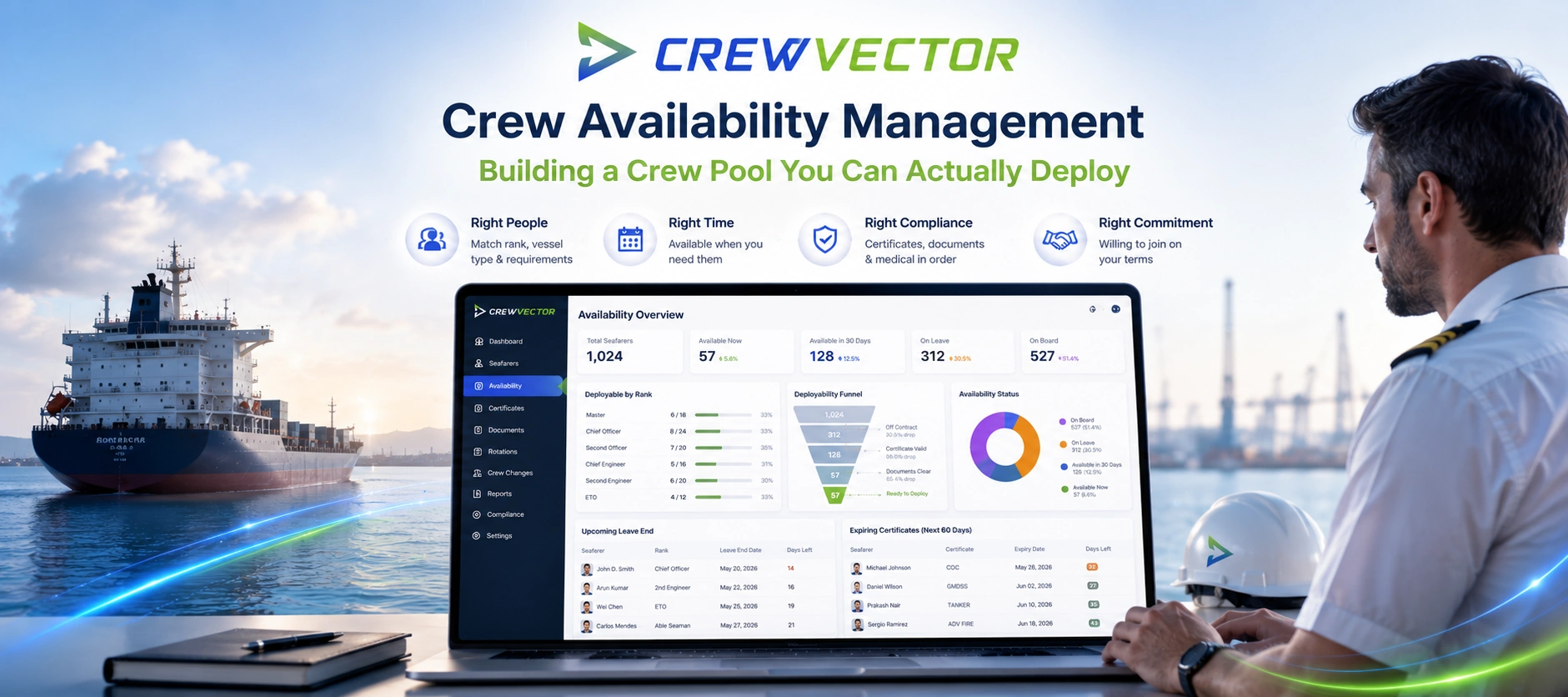
A practitioner guide to crew availability management — the gap between a seafarer being in your database and being genuinely deployable. It breaks down the layers that decide real availability (status and leave, certificate validity, visa/medical readiness, willingness), shows where pools quietly go stale, and explains how to keep one current. Includes a nominal-vs-deployable comparison table, an audit checklist, and a section on why offshore and deep-sea behave differently. Education-first, with Crewvector kept to two light contextual mentions near the end.
22.06.2026
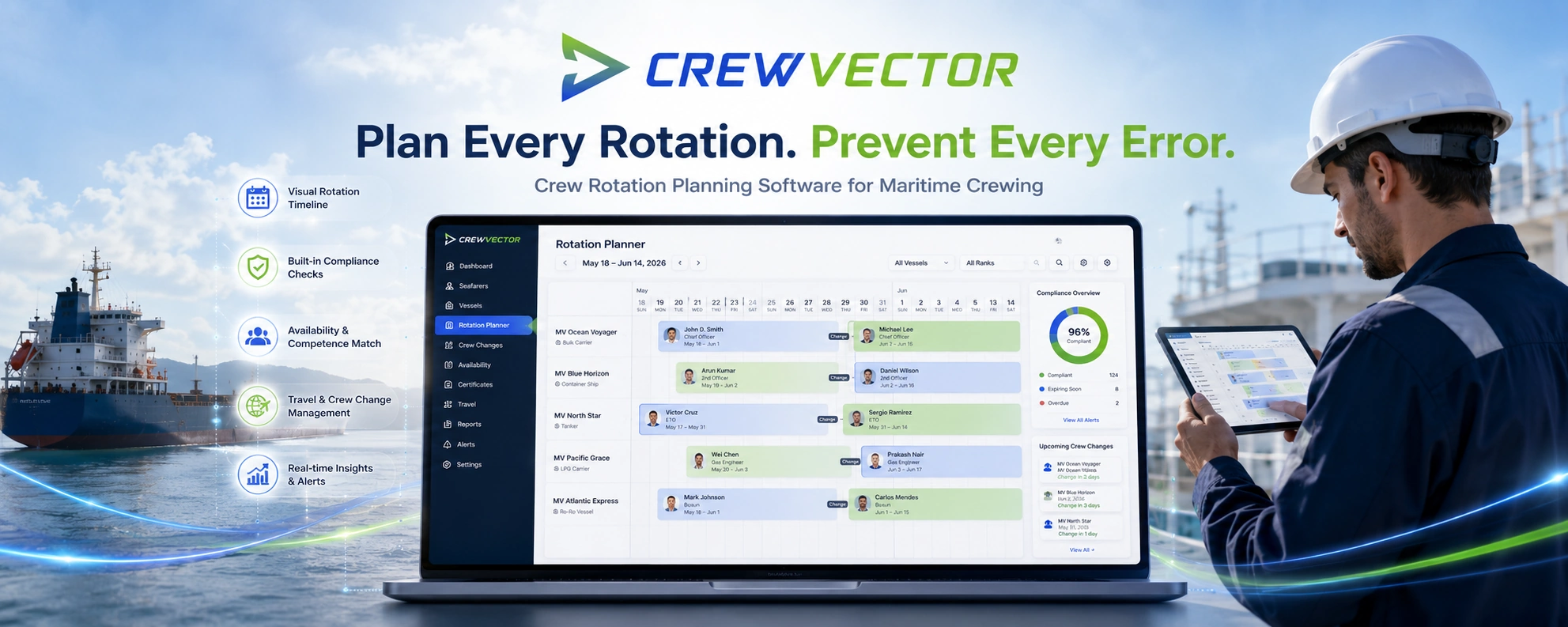
Crew rotation planning software for maritime crewing. Plan rotations, reliefs and crew changes on a visual timeline, with compliance visibility and certificate checks built into every assignment.